
Key takeaways
- Have your old skates checked by a fitter, or get refitted. Feet and boots both change over the years, and old blades usually need work.
- Ease back in with short sessions and the basics. Many returners find stroking and edges come back well before jumps and spins do.
- Since July 2023, Moves in the Field has been called Skating Skills and the free skate tests have been called singles tests. Tests you passed as a kid stay on your record.
- Adults 21 and over can test on the adult track or the standard track, and adult competitions are split by level and often by age.
- Your body needs more warm-up and more recovery than it did at 14. Build up slowly, and stop for sharp pain or a knock to the head.
Maybe it was the Olympics, a friend's birthday skate or a box in your parents' garage with your old skates in it. However it happened, you're thinking about going back to the ice. You won't be the only one, because plenty of adults come back to skating after years away, and you'll meet some of them at the rink.
This guide is for adults who skated as kids or teens and want to start again. If you only went to the odd public skate as a child, our guide to starting figure skating as an adult is a better place to begin. Here you'll find what tends to change, how to ease back in, and what's new with tests and competitions.
What's changed since you last skated
The biggest change is usually you. You may be taller or heavier than you were at 13, your balance point has moved, and you probably bend and bounce back more slowly. None of that stops you skating. It just means your body needs a little time to find its balance on a blade again.
Your head has changed too. As a kid you probably threw yourself at jumps without much thought, and now you know what a broken wrist would mean for work and family. That caution is normal and sensible. Adults also tend to want to know why a skill works, which helps a lot when you're rebuilding one.
The sport has moved on a little as well. U.S. Figure Skating renamed several tests in July 2023, adults have their own test track and championships, and competitions are scored with either the International Judging System or the Component Judging System, which replaced the older 6.0 system in July 2026, depending on the event. If you skated in another country, your national federation runs its own system, so check with them.
Your old skates, or new ones
It's tempting to dig your old skates out of the closet. Deanna Stellato-Dudek famously pulled hers out of her mother's basement at 33 and went on to skate at the Olympics. For most of us, though, old skates are something to show a fitter rather than a plan. Feet can change a lot between your teens and now, and boots wear out.
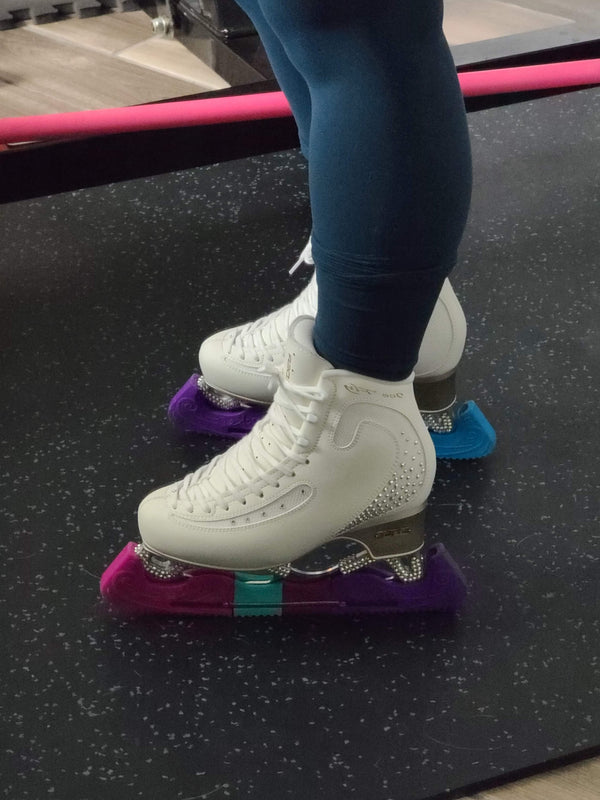
If your old boots still fit snugly, hold your heel down and support your ankle when you bend your knees, they may be fine to start in. If your ankles fold over, the leather is deeply creased or anything pinches, it's time for a new pair. Our skate fitting guide explains what a good fit feels like, how to measure your feet and how lacing changes the fit.
Have the blades looked at either way. A blade that's been in storage may have rust, nicks or dull edges, and one that was sharpened for years may have lost some of its shape. Take them to someone who sharpens figure skates regularly, and our page on when to sharpen your skates explains what they'll look for.
If you're buying new, get fitted in person if you can. Skate sizes don't match street shoes and vary by maker, and a boot that suited a light teenager may be too soft for you now. A boot that's far too stiff is no better, because it stops you bending your knees. Our guide to the best figure skates for adult beginners covers brands and stiffness.


Your water bottle is looking a bit bare
These holographic skating stickers are kiss-cut and water-resistant, and the price drops on its own when you pick three.
Build a bundleYour first sessions back
Pick a quiet session for your first time back, like a weekday daytime public session, or adult ice if your rink has it. Keep it short, and spend it on the basics: stroking, swizzles, stops, edges and a few crossovers. Hold the boards if you want to. Nobody is watching as closely as you think.

Skills tend to come back unevenly. Stroking and crossovers may feel familiar within a session or two, while jumps and spins can take much longer, and your weaker side may feel worse than you remember. Resist the urge to test your old jumps on day one. Get your edges and knee bend back first, because every jump sits on top of them.
Then book a lesson. A single private lesson lets a coach see where you are and suggest what to work on, and plenty of adults keep going from there. If you'd rather start in a group, ask the rink which adult class suits a returning skater. Our page on choosing a coach covers finding one who enjoys teaching adults.
Once you're steady, freestyle sessions give you room for jumps and spins again. Our guide to public, freestyle and adult sessions explains how they work. Rinks set their own rules on jumps, music and right of way, so read the posted rules even if you grew up on freestyle ice.
Old habits and new coaching
Muscle memory is a mixed blessing. A lot of what comes back is good, like a natural knee bend or an edge you never had to think about. Old faults come back too, and a habit you had for years as a kid can be stubborn. Tell your coach what you used to do and how you were taught, so they know what they're working with.
Be ready for some things to be taught differently from how you learned them. Coaches vary, and a new coach may build a skill in a different order or with different cues. If a correction contradicts what you were told at 12, ask about it. A good coach will explain why, and adults usually pick things up faster once they understand the reason.
If you plan to compete, some details may matter more than you remember. Under the International Judging System, the technical panel looks closely at things like jump takeoff edges, and a jump from the wrong edge can lose points. A Lutz that drifts onto an inside edge, often called a flutz, is the classic one to clean up. Our guide to every figure skating jump explains the difference.
Testing again, and the 2023 name changes
If you tested as a kid, you'll notice the names have changed. In July 2023, U.S. Figure Skating renamed Moves in the Field as Skating Skills, and the free skate tests became singles tests. The standard-track levels were renamed at the same time, so you and a newer skater can describe the same test in completely different words.
So if you passed Juvenile Moves in the Field back then, that level is now called Bronze on the standard track. That isn't the same test as Adult Bronze, which belongs to a separate adult track. Our guide to U.S. Figure Skating tests for adults has the full table of old and new names.
Tests you passed stay on your record with U.S. Figure Skating, though you'll need a current membership to test again. Adults 21 and over can test on the adult track, which runs from Pre-Bronze, Bronze, Silver and Gold up through Adult Intermediate, Novice, Junior and Senior, or on the standard track. Which one suits you depends on what you passed before and what you want now, so talk it through with your coach or your club's test chair.
Testing is still optional. Some returners love having a test date to work toward again, and others are happy just to skate. Both are good reasons to be at the rink.
Competing as an adult
Adult competitions are a different world from the ones you might remember. Most adults start at a local nonqualifying competition hosted by a club, where adult events are split by level and often by age. Your level usually depends on the tests you've passed, so check how your old tests count before you enter.
Further on, U.S. Figure Skating runs adult sectional championships and a national adult championship, often called Adult Nationals. Some rinks run ISI competitions instead, which have their own levels and rules. Many competitions also hold showcase events, which are judged on the performance rather than on jumps and spins. Our competition calendar has the dates for those championships, along with the other adult competitions to enter and the big events to watch, month by month, so it's an easy way to see what a season looks like now.
Scoring may be new to you too. Depending on the event, you'll be scored with the International Judging System or the Component Judging System (CJS), which replaced the 6.0 system on July 1, 2026, and the competition announcement says which. Under IJS you get a protocol showing every element and its marks, and our guide to how figure skating scoring works explains how to read one. Our page on preparing for your first adult competition covers the rest.
Pacing yourself and avoiding injury
The hardest part of coming back is often holding yourself back. Your skills may return faster than your strength, and it's easy to do too much in the first few weeks because everything feels familiar. Build up your sessions gradually, take breaks at the boards and stop while your form is still good.
Warm up before every session with a few minutes of easy movement, like marching, leg swings and lunges, and save long, still stretches for afterward. Our stretching routine has a simple version of both. Strength and balance work off the ice help too, and our page on off-ice training has exercises you can do at home.
If you stopped skating because of an injury, or you've had surgery or a health condition since, check with your doctor or a physio before you start back, and tell your coach. Tired muscles and next-day soreness are normal. Sharp pain, swelling, numbness or a knock to the head mean stop and get checked.
Relearn how to fall, too, even if you used to fall without a second thought. Bend your knees, go down sideways onto your hip, tuck your chin and keep your hands in. Our guide to falling safely and getting back up walks through it, and a helmet is a good idea while you find your balance again.
When your nerve takes longer to come back
Lots of returners find that their skills come back before their confidence does. You might know exactly how a jump should feel and still not want to try it, which is frustrating when you used to do it without thinking. That's normal, and breaking skills into small steps with a coach you trust usually helps.
The elephant in the rink is usually the skater you used to be. Try not to measure yourself against the 14-year-old you, who probably had more ice time and a body that bounced. Compare yourself with where you were a few weeks ago instead, and notice the small wins. Our page on building confidence on the ice has more ideas.
Some returners like a goal to work toward, like a test, a competition or one jump they always loved. Our goal-setting guide can help you plan the steps. It's fine if your goals look very different from the ones you had as a kid.
This is general advice from adult skaters, not coaching or medical advice. Your coach can see how you skate now, so if their advice differs from this page, go with theirs.
Sources
Test names come from U.S. Figure Skating's 2026-27 rulebook, and the July 2023 rename dates come from its 2023-2024 Test Grandfathering Chart. The adult track and competition details match our own testing and competition guides. Rules change from season to season, so check the current rulebook or ask your club before you rely on any detail here.
- Adults Skate Too, U.S. Figure Skating tests for adults and preparing for your first adult competition: the adult test track, test records and adult competitions.
- Adults Skate Too, Every Figure Skating Jump Explained (reviewed against the ISU Technical Panel Handbook): takeoff edges and wrong-edge calls for the flip and Lutz.
- U.S. Figure Skating, The 2026-27 Official Rulebook, rules 5012 and 6212 (pp. 151 and 165): the eight adult skating skills and singles test levels and the 21-and-over age rule.
- U.S. Figure Skating, 2023-2024 Test Grandfathering Chart: free skate tests renamed singles tests on July 1, 2023, and Moves in the Field tests renamed Skating Skills tests on July 2, 2023.