
A blade rocker is the subtle curve along the bottom of a figure skating blade, measured as part of an imaginary circle. Most freestyle blades use a 7-foot or 8-foot rocker: the 8-foot curve puts more blade on the ice and feels more stable, while the 7-foot curve pivots faster and rewards precise edges. Neither is better; it comes down to what and how you skate.
Key takeaways
- The rocker is the curve of the blade's bottom edge. A larger circle (8-foot) means a flatter curve and more blade contact with the ice.
- An 8-foot rocker feels stable and forgiving, which suits jumpers and most beginners. A 7-foot rocker turns faster and is standard on dance blades.
- The John Wilson Pattern 99 and Gold Seal both use an 8-foot main rocker. They feel different because of their spin rockers and toe picks.
- Below the axel level, fit and technique matter far more than rocker profile, so ask your coach or skate technician before you upgrade.
If you've ever tried a different blade and thought, "Wait, why does this feel completely different?", you're not imagining things. One of the biggest factors in how a figure skating blade feels on the ice is its rocker, and once you understand it, a lot of blade marketing suddenly makes sense. This guide covers what the rocker is, how 7-foot and 8-foot rockers differ, why two blades with the same rocker can feel nothing alike, and how to choose.
What is a blade rocker?
The rocker is the subtle curve along the bottom of your blade. It isn't flat; it follows part of a giant circle, and most freestyle blades use an 8-foot rocker or a 7-foot rocker, meaning the curve traces part of an 8-foot or 7-foot circle. A bigger circle makes a gentler curve, so more blade touches the ice at once. A tighter circle leaves less blade on the ice, so the blade pivots faster.
That contact length drives almost everything you feel on the ice, including your balance, turning speed, spin entries, and edge control. Most blades also have a second, more sharply curved section near the toe called the spin rocker, which sits under the ball of your foot just behind the toe pick. That's the "sweet spot" you spin on, and its shape matters as much as the main rocker when you compare advanced blades.
Rockers are like tires
Think of it like tires on a car. Wide, flat tires (an 8-foot rocker) are stable and grippy, great for highways. Narrow, rounded tires (a 7-foot rocker) are nimble and quick-turning, great for tight corners. Neither is "better"; it depends where you're driving.
7-foot vs. 8-foot rockers: what's the difference?
This is where it gets practical, because rocker size directly affects how a blade performs for different skating styles. The short version is that the 8-foot rocker trades a little agility for stability, and the 7-foot rocker trades a little stability for agility. Here's how each one behaves.
The 8-foot rocker
An 8-foot rocker has a more gradual curve, so more of the blade stays in contact with the ice. That makes it feel more stable during jumps, landings, and general balance, and more forgiving while you're still building confidence on your edges. You'll find it on freestyle blades such as the John Wilson Pattern 99, the Gold Seal, and the Jackson Ultima Legacy Lite 8, and it's the usual pick for freestyle skaters working on jumps.
The 7-foot rocker
A 7-foot rocker has a tighter curve, so less blade touches the ice at once. You get quicker turns and more agile footwork, because there's less resistance to rotation, but the blade asks for more precision and is slightly less forgiving of sloppy technique. It's standard on dance blades such as the MK Dance and the John Wilson Coronation Dance, which suits ice dancers and advanced skaters working on deep edges and quick transitions.
| Feature | 8-foot rocker | 7-foot rocker |
|---|---|---|
| Curve | More gradual | Tighter, more pronounced |
| Ice contact | More blade on the ice | Less blade on the ice |
| Stability | Higher, great for landings | Lower, requires more control |
| Agility | Moderate | High, with quick pivots and turns |
| Forgiveness | More forgiving | Less forgiving |
| Best for | Freestyle, jumps, beginners | Dance, footwork, advanced edges |
Neither rocker is "better," because this isn't a quality thing; it's a fit thing. A 7-foot rocker on a freestyle jumper is like putting racing tires on a school bus, and an 8-foot rocker on a dancer is like wearing hiking boots to a salsa class. Match the tool to the job, and the blade stops fighting you.


Your water bottle is looking a bit bare
Holographic skating stickers, kiss-cut and water-resistant. Pick three and the price drops on its own.
Build a bundleBlade comparison: Pattern 99 vs. Gold Seal
Two of the most popular advanced blades, the John Wilson Pattern 99 and the John Wilson Gold Seal, both use an 8-foot main rocker. They still feel noticeably different on the ice, and the reason is everything around that main curve, especially the spin rocker and the toe pick. If you're shopping comparable models, the Pattern 99 has a straight-cut pick like Jackson's Elite pick pattern, and the Gold Seal has a cross-cut pick like Jackson's Supreme pick pattern.

| Pattern 99 | Gold Seal | |
|---|---|---|
| Main rocker | 8-foot | 8-foot |
| Spin rocker | Subtle secondary rocker, with less curvature under the ball of the foot | Aggressive secondary rocker, nicknamed the "spinner's blade" |
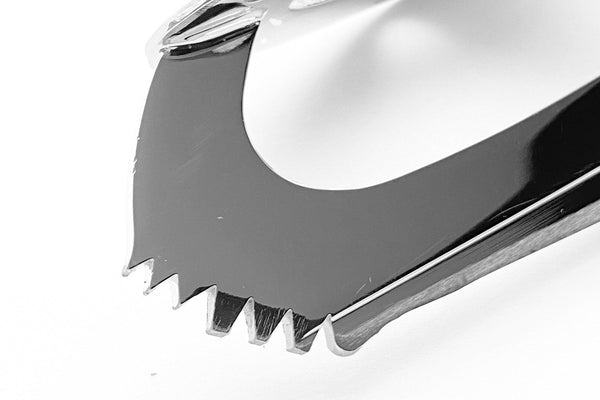
| Toe pick | Straight-cut pick that digs in deeper | Cross-cut picks with a smoother grip |
| Jackson pick pattern with the same cut | Elite (straight cut) | Supreme (cross cut) |
| Best for | Jump-focused freestyle skaters | Skaters who prioritize spins, edges, and footwork control |
The key difference is the spin rocker. The Gold Seal's aggressive secondary curve makes the sweet spot easy to find and keeps spins fast and centered, which is how it earned its "spinner's blade" reputation. The Pattern 99's flatter spin rocker suits skaters who hit the toe pick early, and its straight-cut pick digs deeper into the ice on big jumps.
Both are excellent blades that serve different priorities. If you're jump-focused, the Pattern 99's stability is hard to beat, and if you live for spins and footwork, the Gold Seal's agility is magic. Our full reviews of the Pattern 99 and the Gold Seal go deeper on how each one skates.
Whichever way you go, switching to a blade with a different profile takes adjustment time. Don't judge a new blade after one session; give yourself some easy sessions to get used to the new profile. Your muscle memory needs time to recalibrate, and the first wobbly session tells you very little about the blade itself.
How to choose the right rocker for you
Choosing a blade rocker comes down to three things: what you skate, how you skate, and how far along you are. The table below is a quick decision framework, and the paragraphs after it explain the reasoning. If you'd rather answer a few questions, our blade match quiz does the sorting for you.
| Your focus | Rocker to look for | Why |
|---|---|---|
| Jumps | 8-foot | More stable landings and a reliable takeoff platform |
| Spins and edge work | 8-foot with an aggressive spin rocker, or 7-foot | Faster pivots and less drag in rotation |
| Ice dance | 7-foot | Quick turns, deep edges, and nimble footwork |
| Just getting started | A forgiving 8-foot | Stability matters more than agility early on |
If you're working on jumps, you probably want an 8-foot rocker with a modest spin rocker, like the Pattern 99, because the extra blade contact makes landings feel solid and takeoffs reliable. If you're focused on spins or edge work, a more pronounced spin rocker (like the Gold Seal's) or a tighter 7-foot rocker lets you maneuver more precisely. Less blade on the ice means less resistance when you pivot or enter a spin.
If you're just getting started, stick with a forgiving 8-foot rocker. As a beginner or intermediate skater, stability matters more than agility, and you can always move to a more specialized blade as your skills develop. Your starter blades are doing just fine, and when you're ready to upgrade, our blade guide and our guide to the best boots and blades for adult beginners will help you narrow it down.
One honest caveat before you start shopping: if you're skating below the axel level, your rocker profile probably isn't your limiting factor, so focus on technique and fit first. When you do upgrade, ask your coach or a skate technician, who can match a rocker to your actual skating rather than what sounds cool on paper. And if your rocker questions are really jump questions, our guide to every figure skating jump explains how each takeoff uses the blade.
Sources
Blade specifications in this guide come from the manufacturers' own product pages. Manufacturers update their lines from time to time, so check the current spec sheet before you buy.
- John Wilson Blades, Pattern 99 page and its blade comparison chart: 8-foot main rocker, a subtle secondary rocker with less curvature under the ball of the foot, and a straight-cut toe pick.
- John Wilson Blades, Gold Seal product specifications: 8-foot primary rocker, aggressive secondary rocker, cross-cut toe picks.
- John Wilson Blades, Coronation Dance product specifications: 7-foot rocker.
- MK Blades, MK Dance product specifications: 7-foot rocker.
- Jackson Ultima, Legacy Lite 8 blade page: 8-foot rocker. Apex Advanced blade page: the Elite pick pattern is a straight-cut pick and the Supreme pick pattern a cross-cut pick.