

The right figure skating blade for an adult is the one that matches your level, your discipline, and your boot: the stock blade for basic skills, an intermediate blade like the Coronation Ace or MK Professional once you're working on single jumps, and advanced blades only when you're training doubles. This guide explains the specs that matter (rocker, toe pick, and hollow), compares the major brands, and covers how to keep your blades sharp and rust-free.
Heads up: this guide contains Amazon affiliate links. If you buy through them, Adults Skate Too earns a small commission at no extra cost to you. Details.
Key takeaways
- Match the blade to your actual level: stock blades for basic skills, intermediate blades for single jumps and the axel, advanced blades only for regular doubles.
- Rocker, toe pick style, and hollow change how a blade feels more than the brand name does.
- The John Wilson Coronation Ace and MK Professional are the safe bets for most progressing adults.
- Always have blades mounted by a qualified technician, and never store them in hard guards.
Whether you've just laced up for the first time or you're deep in the axel trenches, your figure skating blades matter more than almost any other gear decision you'll make. They're your only contact with the ice, and the difference between blades that work for you and blades that work against you is real. This guide covers everything adult skaters need to know, from basic anatomy to brand-by-brand comparisons, with no gear-bro gatekeeping.
Blade basics and anatomy
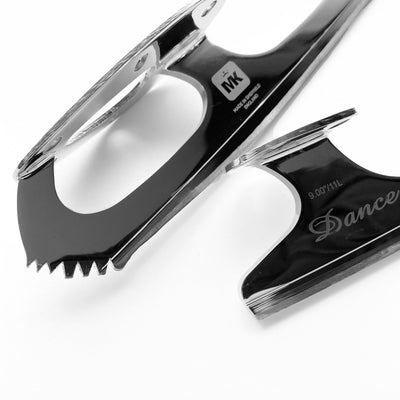
A figure skating blade is the long metal runner attached to your boot that lets you glide, spin, and jump. Unlike hockey blades, figure blades have a concave bottom, hollowed out in the middle, which creates two sharp edges, the inside edge and the outside edge. And yes, those jagged teeth at the front are your toe picks, and they're not for stopping.

The blade's rocker, its curved shape, decides how much blade touches the ice at once and how it handles turns and spins. The rear of the blade handles stroking and gliding, while the front assists with jumps and spins. Think of blades like car tires: the right grip, shape, and sharpness change everything, dull blades are bald tires, and the wrong blade for your level is racing slicks on a city car. Here are the parts you'll hear about.
- Toe pick: the jagged teeth at the front, used for jump takeoffs (toe loops, flips) and certain pivots. Smaller picks are better for beginners, with fewer face-plant opportunities.
- Rocker: the curved profile from toe to heel, measured in feet (7 ft or 8 ft). Only part of the blade touches the ice at once, and most blades have a deeper spin rocker up front and a flatter section toward the rear for gliding.
- Edges: the two sharp sides of the blade, inside and outside. You skate on one edge at a time, and proper sharpening gives you the control to hold them.
- Stanchions: the vertical posts connecting the runner to the mounting plates, which support the blade and connect it to the boot sole.
- Mounting plate: the flat platform where screws secure the blade to the boot at the toe and heel. Advanced plates may allow position adjustments.
- Heel and tail: the heel is the back end, and the tail is how far it extends beyond your boot. Dance blades have shorter tails so you don't trip during complex footwork.
Key specs explained
When you're comparing blades, you'll run into a wall of specs. Each one changes how the blade feels under you, so it's worth knowing what they mean before you compare prices. Here they are in the order they usually matter.
Rocker radius
The rocker radius is the curvature of the blade, measured as the radius of an imaginary circle that fits the curve. The common options are 7 ft and 8 ft, and they trade agility against stability. For more on how the curve shapes your skating, see rockers explained.
| Rocker | Strength | How it feels |
|---|---|---|
| 7 ft | Agility and spins | More curve and less blade contact: quicker turns and deeper edges, but less glide. It's standard on dance blades and found on some freestyle blades too. |
| 8 ft | Speed and stability | Flatter profile and more blade on the ice: better for landings, speed, and stability. Great for beginners and heavier adults. |
Toe pick style
Straight-cut picks have vertically aligned teeth that dig in more, which is great for explosive toe jump takeoffs. Cross-cut picks have an angled criss-cross pattern that grips more smoothly and is more forgiving for newer skaters. In short, cross-cut is smoother and beginner-friendly, straight-cut has more bite, and the Pattern 99's signature straight-cut pick is famous for powerful jump takeoffs.

Hollow (radius of hollow)
The hollow, or radius of hollow (ROH), is the depth of the concave groove sharpened into the bottom of your blade, measured in inches, such as 1/2" or 5/8". A deeper hollow gives more bite and a slower glide, and a shallower hollow gives more glide and less grip.

Your ideal hollow depends on your skating style, weight, and feel preference. Riedell says general purpose blades are often sharpened with a shallower hollow, while higher-level skaters typically use a deeper hollow for edge bite, speed and control. Heavier skaters often go shallower and still get enough grip. Talk to your sharpener, because hollow is an easy, cheap adjustment that can completely change how your edges feel, and once you find your sweet spot, write it down and stick with it.
Blade profile and length
Blades come in sizes that correspond to boot size, and Riedell says the blade should be no more than 1/4" shorter than the sole. Too long and you'll trip on the tail; too short and you lose stability. Dance blades have shorter heels for close footwork, while freestyle blades have longer tails for support on landings.
Blade thickness and side-honing
Most figure blades are about 4 mm thick, and standard blades have a parallel profile, the same width all the way down. Side-honed blades taper inward toward the edges, which reduces drag and weight, so they feel sharper, bite faster, and show a signature hourglass reflection when viewed head-on. They're common on advanced freestyle blades and not necessary for beginners.
Steel type and coatings
High-end blades use stainless steels such as AUS8 (Jackson Matrix) or 440C (Paramount) that hold an edge longer than carbon steel, and Jackson's Apex blades add a titanium coating that hardens the steel. They look cool too, not gonna lie. Just remember that you still need to dry them every single time.
Types of blades
Figure skating blades break into categories by skill level and discipline. Knowing which category you're in narrows the choice fast, so here's the full rundown from entry level to specialty. If any of the vocabulary is new, our guide to skating equipment terminology helps.

Entry-level blades
Entry-level blades are built for beginners and recreational skaters. They prioritize stability, with flatter rockers (often a true 8 ft) and smaller toe picks that won't snag as easily. Popular models include the MK Galaxy, Jackson Ultima Mirage, and Aspire XP, and many come pre-mounted on beginner skate sets.
These blades are for learning basic edges, stops, and turns. Don't expect razor-sharp edges, and don't stress about it, because that's appropriate for where you are right now.
Intermediate blades
Intermediate blades are for skaters working on spins, single jumps, and early axels. They have a more pronounced rocker (often 7 ft), larger cross-cut toe picks for better takeoff grip, and higher-grade steel that holds an edge longer, so they handle all single jumps and even early doubles. The classics are the John Wilson Coronation Ace and MK Professional, along with the Jackson Ultima Legacy (in 7 ft or 8 ft).
This is the sweet spot for most adult skaters who are progressing. John Wilson describes the Coronation Ace as the world's best-selling freestyle blade, and plenty of adults keep using it well into their skating careers.
Advanced freestyle blades
Advanced blades are for skaters training doubles, triples, or quads. They're engineered with aggressive toe picks, refined spin zones, premium steel with heat treatments or coatings, and advanced shaping like side-honing and tapering. Top models include the John Wilson Pattern 99, Gold Seal, MK Phantom, and Gold Star. Most adult skaters won't need this category, but if you're landing doubles consistently and want to level up, the craftsmanship is next-level.
Dance and synchro blades
Dance blades are built for twizzles, deep edges, and intricate footwork, with a shorter tail (less tripping risk), a 7 ft rocker for nimbleness, and low-profile toe picks that stay out of the way during step sequences. Blades made for dance and synchro include the MK Dance, Wilson Coronation Dance, Jackson Ultima Apex Dance, and MK Dynasty. They aren't designed for jumping, and they're genuinely bad at it, so if you want to do both, stick with a freestyle blade at your level.
Specialty and lightweight blades
Lightweight blades use aluminum frames or carbon fiber to cut total weight, which can mean quicker feet, less fatigue, and potentially better jump height. Popular models include the Jackson Ultima Matrix series (aluminum frame with a steel runner), Paramount blades (aluminum frames with steel runners), and the MK/Wilson Revolution (carbon fiber chassis). They can feel slightly different under pressure and may shift your balance at first, but most adult skaters adapt quickly and love them long-term.
Notable blade technologies
Blade makers have introduced plenty of innovations over the decades, and the marketing can make every one of them sound like a must-have. A few are worth understanding, mostly so you know what you're paying for in a high-end blade. Here's the short version of each.
Side-honed blades
On side-honed blades, the sides angle inward to create an inverted "V" cross-section. The narrower contact surface means deeper edge penetration, less drag, and less weight, and you can spot one by its distorted, concave-side reflection. They're part of what you pay for in elite blades rather than something beginners need.
Tapered blades
John Wilson says tapered blades are thicker in the landing zones and thinner in the stroking areas, which gives strong edge grip for takeoffs and landings while keeping glide. The difference in feel is subtle, and most skaters won't notice it unless they compare blades directly.
Lightweight frames (aluminum and carbon)
Lightweight frames are one of the bigger innovations of recent years. Aluminum frames with steel runners, such as the Jackson Matrix and Paramount blades, are built to cut weight, and John Wilson's Revolution series goes to carbon fiber. Many adults love the feel, since lighter means faster feet, and while they take some adjustment at first, they're worth trying if you skate regularly.
Removable blade systems
With a removable blade system, only the steel runner is swapped out, so there's no need to unmount the entire blade. The Jackson Matrix RXS offers this. It isn't mainstream yet in figure skating, but it's worth watching and could be useful for travel or training variety down the road.
Blade brands and models
Here's a breakdown of the major blade makers, with their key models and specs. The tables run from each brand's entry models up to its elite blades. If you'd like to compare the blades our blade quiz recommends in one place, our boot and blade library lists them with the specs each maker publishes and a rough US price.
John Wilson
John Wilson is one of the oldest and most prestigious blade makers, based in the UK. Its Traditional blades are all steel, while the Revolution series uses carbon fiber and steel hybrids, and Wilson blades have powered countless Olympic champions.
| Model | Level | Rocker | Toe pick | Notable feature |
|---|---|---|---|---|
| Coronation Ace | Intermediate (up to doubles) | 7 ft | Cross-cut | Most popular developmental blade worldwide |
| Pattern 99 | Advanced (doubles and triples) | 8 ft | Straight-cut | Toe pick built for explosive jump takeoffs |
| Gold Seal | Advanced and pairs (triples and up) | 8 ft | Cross-cut (large) | Tapered; known as the "spinner's blade" |
| Coronation Dance | Dance and synchro | 7 ft | Cross-cut (small) | Shorter heel for intricate footwork |
MK (Mitchell & King)
MK is the other classic Sheffield brand, and its website lists the same Sheffield address and customer service contact as John Wilson's. It's known for a 7 ft rocker feel and finely tuned spin performance, and its Professional is one of the two default upgrade blades for adults.
| Model | Level | Rocker | Blade style | Notable feature |
|---|---|---|---|---|
| MK Professional | Intermediate (up to axel and doubles) | 7 ft | Parallel | Stable entry freestyle blade; great for adults learning spins and jumps |
| MK Phantom | Advanced (triples) | 7 ft | Tapered | Aggressive spin rocker |
| MK Gold Star | Advanced (triples and quads) | 7 ft | Tapered | Aggressive spin rocker |
| MK Dance | Dance (advanced) | 7 ft | Parallel | Small rounded toe pick; higher stanchions for deeper lean angles |
Jackson Ultima
Jackson Ultima offers strong performance at friendlier prices. Its Matrix series is especially popular with adult skaters for its lightweight aluminum construction, and its Legacy line is a favorite with progressing adults.
| Model | Level | Rocker | Notable feature |
|---|---|---|---|
| Ultima Mirage | Entry | 8 ft | Chrome finish, straight-cut pick; paired with the Elle boot |
| Aspire XP | Entry and basic skills | 8 ft | Chrome finish, cross-cut pick; paired with the Freestyle boot |
| Legacy 7 / Legacy 8 | Step up from introductory blades | 7 or 8 ft | Lightweight cutout design, cross-cut pick |
| Apex Elite | Advanced | 8 ft | Titanium coated stainless steel, tapered edges, straight-cut pick |
| Apex Supreme | Advanced | 8 ft | Titanium coated stainless steel, cross-cut pick |
Riedell Eclipse
Riedell's Eclipse line offers high-quality stainless steel blades that are solid alternatives to the UK brands. Riedell's 2026 catalog lists four Eclipse blades, and its FAQ also describes the Eclipse Titanium Infinity, which has a titanium alloy body with a stainless-steel runner.
| Model | Use | Rocker | Toe pick |
|---|---|---|---|
| Selene | Competitive, mid-range | 8 ft | Straight-cut |
| Vesta | Competitive, beginner | 7 ft | Straight-cut |
| Capri | Beginner, recreational | 7 ft | Straight-cut |
| Luna | Beginner, recreational | 7 ft | Straight-cut |
Paramount
Paramount makes lightweight aluminum-framed blades with steel runners, engineered to mimic Wilson and MK performance profiles with significantly less weight. They're popular with adult skaters looking to reduce fatigue.
| Model | Profile | Steel grade | Notable feature |
|---|---|---|---|
| Paramount SS 27 | Pattern 99 profile | 440C stainless steel available | Lightweight aluminum holder with a steel runner |
| Paramount SS 12 | Gold Seal profile | 440C stainless steel available | Lightweight aluminum holder with a steel runner |
Other brands
A few other names come up. Graf makes high-end Swiss blades of excellent quality that are less common in North America. Edea sells boots as sets with blades, for example the Overture set with the Charme blade.
How to choose the right blades
Choosing blades feels overwhelming, but it doesn't have to. Work through these questions in order and the shortlist mostly writes itself. If you're still choosing boots too, start with our guide to the best boots and blades for adult beginners.
1. Be honest about your skill level
This is the number one factor. Blades must match your actual abilities, and a super-advanced blade can hinder a beginner, with big toe picks and aggressive rockers tripping you up before you're ready. Technique trumps equipment every single time: a good blade complements your skating, but it doesn't carry you.
As a rule of thumb, choose an entry-level blade if you're working on basic skills and early single jumps. Move to an intermediate blade once you're confidently doing all single jumps and starting the axel or doubles. Consider advanced blades only once you're training doubles regularly.
2. Match your skating discipline
Freestyle skaters need standard freestyle blades, and you don't need advanced blades if you're not doing triples. Dance and synchro skaters benefit from dance blades for footwork and deep edges, but freestyle blades offer more versatility if you do both. For recreational skating, a solid intermediate blade is more than enough for a great experience on the ice.
3. Match the blade to the boot
Blades must fit your boot size and match its support level. A high-level blade on a soft recreational boot is overkill, because the boot won't provide the ankle support that blade assumes you have. Boot and blade should be level-matched, and our boots and blades guide for adult beginners shows which pairings make sense.
4. Factor in your body
Heavier skaters may prefer a shallower hollow, since they need less bite for enough grip, and taller adults often prefer an 8 ft rocker for added stability. All-steel blades are the safest bet for durability. Lightweight blades are great too, but make sure they're rated for your skating level and weight.
5. Avoid the common mistakes
Don't overblade. Higher-level blades won't instantly make you better and may hurt your progress if you're not ready, because big picks catch on the ice and aggressive rockers feel unstable until your technique catches up. Don't underblade forever, either: a stock blade that can't hold an edge, or one with a rocker flattened by over-sharpening, will hold you back once you're progressing.
Above all, never skip professional mounting. Poor alignment ruins even the best blade, and this is not a YouTube DIY situation. Our guide to common adult skating mistakes covers a few more traps worth avoiding.
6. Budget realistically
Factor in how often you'll need sharpening, resale value (used blades are fine), and how many times a week you're actually on the ice. A blade you'll skate on four times a week deserves more of your budget than one you'll use once a month.
7. Talk to your coach or technician
Seriously, ask. Questions like "Is my current blade holding me back?", "Would a 7 ft or 8 ft rocker suit my skating better?", and "Is my sharpening schedule affecting my performance?" are exactly what they're there for. You're not going to annoy them.
Best blades for adult skaters
If you want a quick, level-based recommendation, these are the safe bets adult skaters keep coming back to. Each group builds on the one before, so start with the level you're at today rather than the one you're aiming for.
| If you are | Our picks | Notes |
|---|---|---|
| A beginning adult | The blade that came on your skates; budget upgrade: Jackson Ultima Aspire XP or Mirage; long-term: MK Professional or Coronation Ace | No need to upgrade until you pass basic skills; the Pro or Ace will carry you through all single jumps |
| Working on single jumps or the axel | Coronation Ace or MK Professional | Tried, tested, and trusted through the axel and into early doubles |
| Working on doubles | Stay on the Ace or Pro, or step up to the MK Phantom or Pattern 99; Ultima Apex Elite or Supreme also perform well | Many adults like Paramount lightweight blades to reduce fatigue on landings if they're putting in serious hours |
| A dance or synchro skater | Coronation Ace at lower levels; MK Dance or Ultima Apex Dance for advanced pattern dances and close partner work | Ultima Legacy Finesse is made for intermediate dance and synchro skaters |
| A heavier adult skater | An 8 ft rocker and high-quality steel | Ask your sharpener about a shallower hollow for edge control without over-biting |
Blade care and maintenance
You spent real money on these things, so here's how to make them last. Most of blade care is a few habits repeated every session. For the full routine, including boots, see Skate Care 101.

Sharpening
Riedell says it's time to sharpen when you start to slip on an edge, skid into a jump entry or wash out on a landing, and how often that happens varies by skater and blade. Other signs include spins skidding out and edges that won't hold. Don't wait until the blade is completely dull, because skating on dull blades stalls progress fast.
Always use a figure skating sharpener, not a hockey shop. Tell them your preferred hollow every time, and once you find a setting that works, write it down. If your blades feel too grippy after sharpening, ask for shallower next time, and if they feel slippy, go deeper.
Guards, drying, and rust
Put hard guards on when walking off the ice, but never store your skates with hard guards on, because they trap moisture and cause rust; switch to terrycloth soakers for storage. Wipe your blades down thoroughly after every session, and a small microfiber towel works well. Don't zip wet skates into an airtight bag, either; let them air out at home before you pack them away. A set of guards and soakers is an easy gift for a skater, and there's one in our gift guide.
Even stainless steel can rust if you're not careful. If you see any rust or nicks, have your blades serviced by a professional before you skate on them again, because rusty blades feel like they skid or slip. For long-term storage, a light coat of oil (machine oil or WD-40) helps.
Things to avoid
Never walk on dirty rubber mats, because grit and metal shavings can nick your edges. Don't tap your blades together, a habit that damages edges over time, and use soakers in your bag so the blades never touch each other. These sound small, but they're the difference between sharp edges and a sharpening bill every few weeks.
Mounting and travel
Check your screws occasionally, and if you feel a click or wobble, a screw is probably loose, so tighten it carefully with the correct screwdriver. For Edea skates, follow Edea's instructions, which say to use only the Edea screws that come with the boots. When flying, protect your blades with hard guards, towels, or blade pouches, and if you must check them, wrap them so they can't bang around.
See everything I actually use on the AST Amazon storefront.
Sources
Specs come from the blade makers' own pages and catalogs, and they can change from season to season. Advice on levels, hollows, and care reflects common practice among coaches and skate technicians, so check with yours before changing anything.
- John Wilson, product pages for the Coronation Ace, Pattern 99 (with its blade comparison chart), Gold Seal and Coronation Dance, the Revolution series page and Made in England: rockers, toe picks, tapering, the world's best-selling freestyle blade, carbon fiber Revolution blades and the Sheffield address.
- MK Blades, the MK Dance page (with its comparison chart for the Professional, Phantom, Gold Star and Dance), the Phantom and Dynasty pages and the home page: rockers, toe picks, tapering and the Sheffield address.
- Jackson Ultima, blade pages for the Mirage, Aspire XP, Legacy Lite 7 and 8, Legacy Finesse, Apex Advanced, Apex Dance, Matrix Advanced and Matrix RXS, and the Perfect Match page: rockers, picks, finishes, steel and coatings, and which boot each blade comes with.
- Riedell, 2026 catalog (Find Your Perfect Eclipse Blade, PDF p. 18, and the sharpening and blade care pages) and Frequently asked questions: the four current Eclipse blades, when to sharpen, hollow, blade length and rust, and the Eclipse Titanium Infinity.
- Paramount Skates, blade information page and brochure: SS 27 and SS 12 profiles, 440C stainless steel and the aluminum holder with a steel runner.
- Edea, What's my size, Frequent questions and Blade mounting pages: the 4 mm blade, boots sold as sets with blades, and Edea's own screws.




1 comment
Great tutorial! Glide on….