
Most adults keep skating affordable by starting with group classes, rental skates and public sessions, then adding freestyle ice, private lessons and their own skates a step at a time. Ice time and lessons are the costs that come around every week, so that's where most of the savings are. These nine habits come from our cost guide and the rinks and makers we checked.
Key takeaways
- Start with rental skates and a group class, and practice on public sessions, which are usually the cheapest ice.
- Buy ice in packs once you skate often, since the price per session usually drops.
- For a first pair, a beginner set from a figure skating brand is all most adults need.
- Tests, competitions and club membership are optional extras, so plan for them separately.
Most of us didn't budget for figure skating when we started. It begins with a class and some rental skates, and a year later there's freestyle ice, a coach and your own boots. None of that has to happen at once, and plenty of adults skate happily on a small budget.
Below are nine ways to keep the cost down without skating less. Prices vary a lot by region and rink, so any figure here is an example, not a rate to expect. Our guide to the real cost of adult figure skating goes through every cost in turn.
1. Start with a class and rentals
Most adults start with group classes, often a Learn to Skate USA program with adult levels. Rinks usually price them by the session of several weeks, and some include skate rental and practice passes in the fee. Rental skates are fine for your first classes, so you don't need to buy anything to find out if you like it. A class that includes practice passes is good value, because it gives you somewhere to practice what you learned.
2. Practice on public sessions
Public sessions are usually the cheapest ice and the easiest to fit into a week. They're fine for stroking, edges and crossovers, though many rinks don't allow jumps or spins on them. If your rink runs an adult public session, it's often a calmer place to practice too. Our guide to ice time explains public, freestyle and adult sessions and how to read a rink schedule.


Your water bottle is looking a bit bare
Holographic skating stickers, kiss-cut and water-resistant. Pick three and the price drops on its own.
Build a bundle3. Buy ice in packs
Once you skate more often, buy ice in packs rather than one session at a time. At Poway ICE in California, for example, a 10 pack of hour-long freestyle sessions works out to $16.50 a session and a 75 pack to $14. It's also worth asking whether quieter weekday sessions cost less. Read the rink's terms before you buy a big pack, in case it has an end date.
4. Share or space out private lessons
Private lessons cost more per minute, but you get a coach's full attention. A semi-private lesson with a skating friend at your level splits the coaching fee. Some adults take a private lesson every other week and practice what they learned in between, which keeps the cost down. Before you start with a coach, ask how long a lesson is, what it costs and how they bill, and our guide to choosing a coach has the full list.
5. Buy a beginner set first
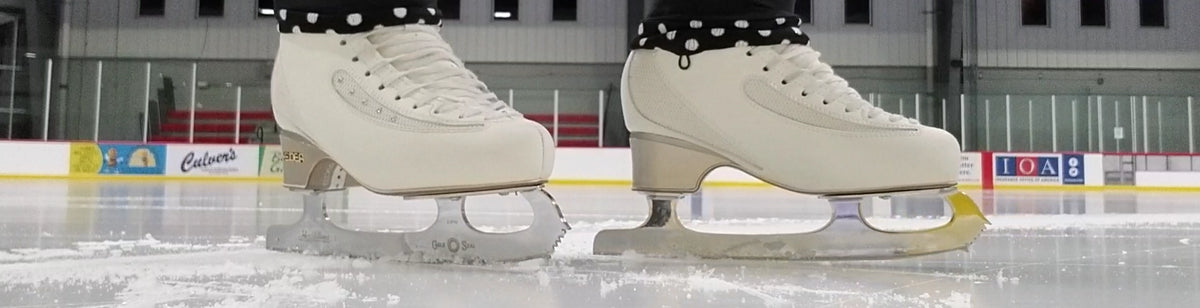
For a first pair, a boot and blade set from a figure skating brand is all most adults need. Riedell's 2026 list price is $165 for its Ruby set and $219 for its Topaz set. Riedell also says sets are often more affordable than separate boots and blades and designed for entry-level skating. Buying a boot to grow into usually backfires, so buy for the skater you are now.
6. Have used skates checked first
Used skates can save money if they still have their support and fit your feet. Have a skate shop check them before you buy, because a pair that needs new blades and repairs can cost more than a new set. Our guide to new versus used figure skates shows what to check.
7. Look after your blades
Look after your gear and it lasts longer. Wipe your blades after every session, use guards and soakers, and don't sharpen more than you need to. Hard guards for walking off the ice and soft soakers for your bag both make a sharpening last longer. Our sharpening guide explains the signs that it's actually time.
8. Treat tests and competitions as extras
Tests, competitions and club membership are optional extras, so you can skate for a long time without them. You do need a U.S. Figure Skating membership to take its tests, and joining a member club usually includes it in the dues. Competition entry fees are listed in each event's announcement, and travel, coach fees, an outfit and music editing can come on top. When you do want them, plan for them separately as one-off costs.
9. Write down a simple budget
Multiply the sessions you'll skate each week by the price per session, then multiply by four. Add your class or lesson fees for the month, and set a little aside for sharpening. If you'd like somewhere to write it down, our printable Skating Budget Planner is $6, with a page for each month and a year summary. Then decide what matters most, whether that's skating twice a week or saving for better skates.
Saving on the small stuff
Our shop has a few deals that come off in the cart with no code, which helps with the small things a skater goes through. Sticker packs are 18% off three, 25% off five and 32% off ten, and a second pair of laces is half price when you buy two. The Competition Prep Kit and Scoring Cheat Sheet are $10 together.
Sources
- Adults Skate Too, The Real Cost of Adult Figure Skating (updated October 2026): every practical tip on this page, which Erika wrote and checked.
- Poway ICE, Freestyle page: freestyle package prices.
- Riedell, 2026 ice catalog, price list (US MSRP): Ruby and Topaz set prices.
- Riedell, What You Need to Know When Buying Your First Figure Skates (blog): why sets suit beginners.
- Adults Skate Too product pages, read live on Oct 13 2026: the Skating Budget Planner and the Ways to save offers.