
Every figure skating blade has two edges: the inside edge on the big-toe side and the outside edge on the little-toe side. An outside edge curves toward the outside of your skating foot, so a right forward outside edge curves to the right, and an inside edge curves the other way. Holding each edge, forward and backward on both feet, is the base for crossovers, turns, jumps and spins.
Key takeaways
- Your blade has an inside edge on the big-toe side and an outside edge on the little-toe side, with a shallow groove called the hollow between them.
- An outside edge curves toward the outside of your skating foot, and an inside edge curves toward the inside. On your right foot going forward, outside curves right and inside curves left.
- Two feet, two edges, forward and backward: that makes eight basic edges, written as short codes like RFO (right forward outside) or LBI (left back inside).
- An edge comes from leaning your ankle, knee and body into the circle together, not from twisting your shoulders.
Edges are the part of skating nobody films, and the part every other skill is built on. Your crossovers, three-turns, jumps and spins all come down to which edge you're on and how steadily you can hold it. Edges can be confusing at first, because the names describe the blade while the curve you feel depends on which foot you're on and which way you're going. This page sorts that out.
Your blade's two edges
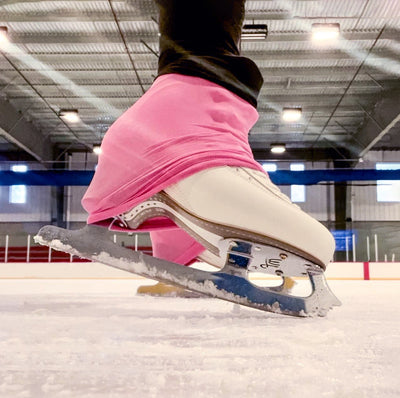
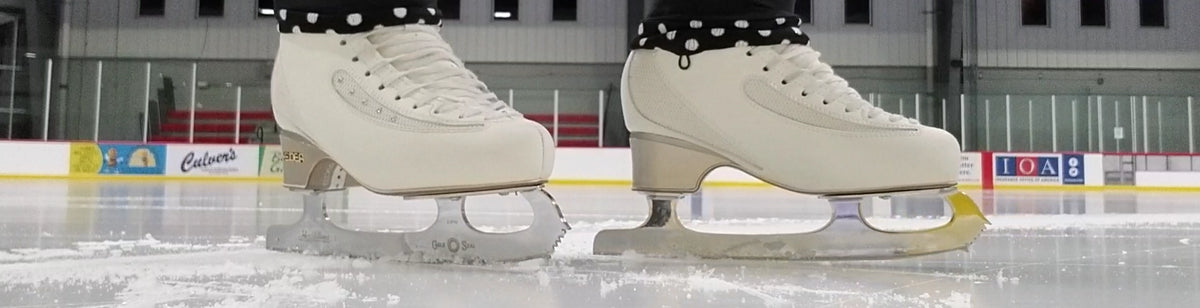
Look at the bottom of a figure skating blade and you'll see it isn't flat. A shallow groove, called the hollow, is ground along its length, which leaves a sharp edge on each side. The inside edge is the one on the big-toe side of your foot, and the outside edge is on the little-toe side. When the blade sits straight up on both edges at once, you're on a flat.

To get onto an edge, you tilt the blade by leaning, and the edge grips the ice and carries you around a curve. You can feel the tilt standing at the boards: roll your ankle gently in toward your other foot for the inside edge, or out for the outside edge. On the move, the lean comes from your ankle, knee and hip together, with your body leaning into the circle over the skating foot.
Which way each edge curves
Here's the rule: an outside edge curves toward the outside of your skating foot, and an inside edge curves toward the inside. So if you glide forward on your right foot and lean onto the outside edge, you curve to the right. Lean onto the inside edge of the same foot and you curve to the left, toward your other foot. On your left foot it's all reversed: the outside edge curves left and the inside edge curves right.
The same rule holds going backward, which helps when backward edges start to feel like a different language. On a right back outside edge you're still leaning to the right, so the center of your circle is on your right side. A simple check for any edge is that the center of the circle is on the side you're leaning toward.


Your water bottle is looking a bit bare
Holographic skating stickers, kiss-cut and water-resistant. Pick three and the price drops on its own.
Build a bundleThe eight edges at a glance
Two feet, two edges and two directions make eight basic edges. Coaches and skating skills patterns write them as three-letter codes: foot (R or L), direction (F or B) and edge (I or O), so RFO is right forward outside and LBI is left back inside. The last column assumes you rotate counterclockwise in jumps and spins, as most skaters do; if you rotate clockwise, swap left and right.
| Edge | Code | Center of the circle is on your | Seen from above, you travel | Where you'll meet it |
|---|---|---|---|---|
| Right forward outside | RFO | Right | Clockwise | The gliding foot in clockwise forward crossovers |
| Right forward inside | RFI | Left | Counterclockwise | The crossing foot in counterclockwise forward crossovers |
| Left forward outside | LFO | Left | Counterclockwise | The gliding foot in counterclockwise forward crossovers; the waltz jump and axel takeoff; forward spin entries |
| Left forward inside | LFI | Right | Clockwise | The crossing foot in clockwise forward crossovers |
| Right back outside | RBO | Right | Counterclockwise | Jump landings; the back spin; the gliding foot in counterclockwise backward crossovers |
| Right back inside | RBI | Left | Clockwise | The end of a right forward outside three-turn |
| Left back outside | LBO | Left | Clockwise | The Lutz takeoff |
| Left back inside | LBI | Right | Counterclockwise | The Salchow and flip takeoffs; the end of a left forward outside three-turn; the crossing foot in counterclockwise backward crossovers |
Practicing forward edges
Inside edges
Forward swizzles are a gentle way to feel your inside edges, because both feet press on their inside edges as they slide apart. From there, try one-foot glides on a curve. Push onto your right foot, bend the knee and lean gently to the left, so you curve toward your free side, with your left leg extended behind you. Hold it as long as it feels steady, then do the same on your left foot, curving right.
Outside edges
Outside edges feel bolder, because you're leaning away from your free leg. A classic way to practice is half circles down the length of the rink: push onto your right foot and curve right on its outside edge, then step onto your left foot and curve left, and keep alternating. Keep the skating knee bent and the free leg behind you, and let the edge make the curve instead of steering with your shoulders.
On both kinds of edge, start with shallow curves and short glides. A steady shallow edge teaches you more than a deep one you can't hold, and the curve gets deeper on its own as you get more comfortable leaning. Try both feet every time, even if one is clearly your favorite.
Backward edges
Backward edges come once you're comfortable skating backward and gliding backward on one foot. If you rotate counterclockwise, the right back outside edge deserves extra time, because it's the edge you'll land your jumps on and the edge your back spin turns on. Practice it as a glide on a circle with your right knee bent and your left leg extended behind you, then try the left foot too.
Back inside edges work the same way, as one-foot glides on a curve with your body leaning toward your free side. Check behind you before each one and glance back as you go. Like everything backward, they take a while to feel normal, so keep them small and steady at first.
Where edges show up
Once you know your edges, you start seeing them everywhere. In a crossover, the inside foot glides on its outside edge and the crossing foot lands on its inside edge. A three-turn is a one-foot turn from forward to backward that changes edge, so a forward outside three-turn ends on a back inside edge. A mohawk turns you from forward to backward by stepping from one foot to the other, usually keeping the same kind of edge.
Jumps are named largely by their takeoff edge. For counterclockwise skaters, the waltz jump and axel take off from the left forward outside edge, the Salchow from the left back inside edge and the loop from the right back outside edge. Almost every jump lands on the right back outside edge. Our guide to every figure skating jump goes through them all, and the waltz jump guide starts with the first one.
Spins use edges too. If you rotate counterclockwise, your forward spins are on your left foot, usually entered from a left forward outside edge, and your back spin turns on your right back outside edge. Our first spins guide covers both.
U.S. Figure Skating's skating skills tests, which were called Moves in the Field until 2023, are built mostly from edge, turn and stroking patterns. If you're curious about testing, our page on U.S. Figure Skating tests for adults explains how the levels work. Even if you never test, those patterns are a good map of what to practice next.
Common edge problems
The most common problem is skating on a flat: the blade stays upright, so you go straight instead of curving. It usually means you're nervous about leaning. Bend your skating knee more and let your ankle and body tip into the circle a little at a time, because a shallow curve is a fine place to start.
The next is leaning with your shoulders while your blade stays flat, or bending at the waist to look for the curve. Your body should lean as one piece over the skating foot, with your head up and your eyes looking along the curve. Stiff, straight knees make all of this harder, so keep a soft bend in your skating knee the whole time.
Wobbling between edges usually means the lean isn't committed, and tired ankles make it worse. Short bits of edge work in every session tend to help more than one long session. If your ankles keep collapsing inward no matter what you do, ask your coach or a skate fitter to look at your boots and how you lace them.
Edges are worth practicing for as long as you skate. A few minutes of them at the start of a session is a good warm-up, and you'll find that everything after it feels steadier.
This is general advice from adult skaters, not coaching. A coach can see things you can't feel, so if something here doesn't match what yours teaches, go with your coach.