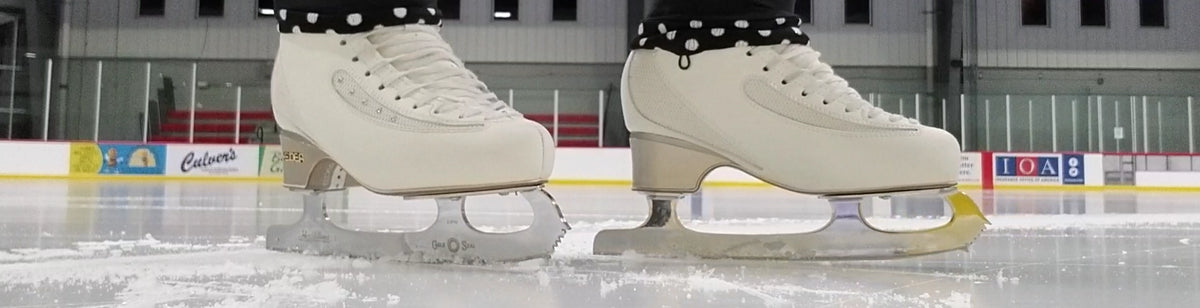

Most adults learn to skate backward in stages: backward wiggles, then backward swizzles, then backward stroking. A backward stroke pushes out to the side and around toward the front on the inside edge, in a C shape, and your pushing leg finishes extended in front of you. Keep your knees bent, your weight over the balls of your feet, and look behind you often.
Key takeaways
- Keep your knees bent and your weight over the balls of your feet. Rocking back onto your heels makes a backward fall much more likely.
- Start on two feet with backward wiggles and backward swizzles before you push from one foot at a time.
- A backward stroke is a C-shaped push on the inside edge that sweeps out and toward the front. Your free leg finishes in front of you, not behind.
- Look over your shoulder before you start and every few seconds as you go, and learn a backward stop early.
Skating backward is one of the first big milestones for adult skaters, and one of the scariest. You can't see where you're going, a backward fall feels like the worst kind, and every movement seems to run in reverse. It does get easier, usually sooner than you'd believe, and plenty of skaters end up loving it.
Getting your stance right
Almost everything about skating backward comes down to where your weight sits. Stand with your knees bent and your chest up, as if you're about to perch on a high stool, and keep your weight over the balls of your feet. If your weight drifts back onto your heels, it becomes very easy to tip over backward.
Hold your arms out to the sides, a little in front of you and around waist height, which helps your balance and keeps your shoulders level. Don't fold forward at the waist, though. The bend belongs in your knees and ankles, with your back fairly upright.
Backward wiggles
Many classes start backward skating with backward wiggles. Begin near the boards with your feet side by side, knees bent and weight over the balls of your feet. Shift your weight from one foot to the other, pressing out a little with each foot and letting your hips sway side to side, and each little press sends you backward. If you aren't moving, try walking backward slowly with your toes turned in to get the feel of it.
Start small. A few feet of wiggles away from the boards and back again is a real achievement on your first day. Glance over your shoulder before you go, so you know the space behind you is clear.
Backward swizzles
Backward swizzles are the backward version of the forward swizzles you probably already know. Start with your toes together and your heels apart, like an upside-down V. Press on your inside edges to push your heels out, so your feet slide apart to about a foot from each other. Then rise and bring your heels together into a backward glide on two feet, and repeat, tracing a lemon shape on the ice.
Bend your knees as your feet slide apart and rise a little as they come back together. That bend and rise is what powers the swizzle, and once you feel it, you'll move backward with far less effort. When you can link several in a row without stopping, you're ready to try stroking.
Backward stroking
Backward stroking means pushing from one foot at a time. The push is often called a C push or C-cut, after the shape the pushing blade draws on the ice. It's the reverse of what many people expect, because the push goes out and toward the front rather than straight back.
Glide backward on both feet, then shift your weight onto your right foot. Turn your left toe in so the heel points out, press into the left blade's inside edge, and push the foot out to the side and around toward the front, drawing a C on the ice. Finish with your left leg straight and extended in front of you, lifted just off the ice.
Then bring the left foot back under you, set it down beside your right, move your weight onto it and push with your right foot the same way. Push with the whole blade rather than the toe pick, keep your gliding knee bent, and stay over the ball of your gliding foot. Start with small pushes and short glides on each foot, and the length will come.
If it feels backward, think about which way you're traveling. You're moving backward, so a push has to go out and toward the front to send you the other way, and a push straight back toward where you're going wouldn't move you at all. That's also why your free leg ends up in front of you rather than behind.
Looking where you're going
Check behind you before you start, and keep glancing over your shoulder every few seconds as you go. Alternate shoulders so you see both sides, and turn your head without twisting your whole body. On a public session, skate with the flow of traffic and give yourself extra room, since other skaters may not expect someone coming backward. Our page on rink etiquette covers sharing the ice.
Stopping
Ask your coach to teach you a backward stop early, so you're never stuck waiting to coast to a halt. Learn-to-skate classes usually teach a backward snowplow stop, which skids the blade to slow you down, and it's worth learning on each foot. A stop is much easier to learn with someone watching your foot angle, so this is one to get shown in person.
Until your backward stop feels reliable, practice near the boards and keep your speed low. Being able to stop when you want to takes a surprising amount of the fear out of going backward. It also makes you a much easier skater to share a busy session with.
Falls and nerves
Most of the fear around skating backward is fear of falling backward, and it's a fair worry. Practicing how to fall before you need to takes a lot of that fear away: bend your knees, sit down to one side rather than straight back, and tuck your chin. Our page on falling safely and getting back up walks you through it.
Gear can help too. Gloves are worth wearing every time you skate, and padded skating gloves add cushioning on the palm. A helmet is a good idea while you're learning, especially for backward falls, and padded shorts under your leggings take the sting out of landing on your hip. Wear whatever helps you relax, and leave it at home once you don't need it.
Expect a few sessions where it feels like nothing is happening, and then one where it suddenly clicks. Skating backward on a quieter session, near the boards or next to a friend, is a gentle way to build up. If nerves are keeping you off the ice, our page on overcoming fear on the ice has more ideas.
What comes next
Once backward stroking feels comfortable, you'll start gliding backward on one foot and working on backward edges. After that come backward crossovers, and turns that take you from forward to backward and back again, like three-turns and mohawks. Jumps land backward too, so this is also the start of the road to your first jump.
This is general advice from adult skaters, not coaching. A coach can see things you can't feel, so if something here doesn't match what yours teaches, go with your coach.