
Sharpen your figure skates when your edges start to slip, your stops lose their bite and your blades skid out of turns they used to hold. How often depends on how much you skate, the ice and how you look after your blades, so keep track of your hours and watch for the signs. New blades usually need a proper sharpening before their first skate, too.
Key takeaways
- Edges that slip and stops that skid are the main signs. How your blades feel on the ice is a better guide than the calendar.
- There's no single right number. Keep a rough count of your hours between sharpenings, and you'll soon learn how your own blades wear.
- Take your skates to someone who sharpens figure skates regularly, and ask for the same hollow each time once you've found one you like.
- Hard guards for walking, soft soakers for storage and a towel after every session keep a sharpening going for longer.
Sharp blades are easy to take for granted until they're gone. One week your edges hold, and a few weeks later you're sliding off your crossovers and wondering what happened to your skating. Often it isn't you, it's the blades. Knowing the signs means you can get them sorted before dull edges start knocking your confidence.
This page is about figure skates, which are sharpened differently from hockey skates. If you're still on rental skates, the rink takes care of sharpening, so this is something to come back to once you have your own pair. Rental blades vary a lot, though, and if a pair feels slippery it's fine to ask for another.
Signs your blades need sharpening
The clearest sign is edges that won't hold. You lean into a curve or a crossover and the blade slides out sideways instead of carving. Stops take more effort and more distance, turns feel skiddy, and spins drift or scrape more than usual. If you've been skating well and suddenly everything feels slippery, check your blades before you blame your technique.
Other signs are subtler. A dull blade can feel as if it's skating on top of the ice instead of in it, or it can chatter on a curve. A nick from the boards or another blade, or a rust spot, can catch or slip in one place only. If one skate feels fine and the other doesn't, the problem may be that one blade.
How often to sharpen
There's no official schedule, and skaters and sharpeners don't all agree on the numbers. Someone who skates an hour a week and someone who's on the ice most days will need very different gaps between sharpenings, which is why counting hours works better than counting weeks. Ask your sharpener or coach what they'd suggest for you, then adjust as you learn how your blades wear.
Plenty of things can shorten that. Hard or dirty ice, outdoor ice, walking on the wrong surfaces, knocks against the boards and rust all wear edges faster. Your own feel matters too, since some skaters notice a dull edge quickly and others don't mind a little less bite. If your edges seem to fade faster than your friends' do, one of these is often why.
Keep a quick note of when you sharpen and roughly how many hours you've skated, in a notes app or a paper log. Our printable Skate Care Log has a page for each of those if you'd like it on paper. After a few sharpenings you'll see your own pattern. Don't sharpen more than you need to, either. Every sharpening removes a little steel, and over the years that wears the blade down and can flatten its rocker.
Checking your edges at home
You can check your edges with your fingernail. Hold the skate upside down and gently drag your nail across the edge, from side to side, not along it. A sharp edge catches and feels like it bites into the nail a little, while a dull one lets the nail slide straight off. Try a few spots along each edge, inside and outside, on both blades.
Blades are sharp enough to cut skin, so never test them by running a finger along the edge. While you're looking, check for nicks, burrs and rust spots, which often feel like a rough patch. Light surface rust can sometimes be cleaned off, so ask your sharpener how they'd like you to do it. A chipped or badly rusted edge needs a sharpener.
Finding a good sharpener
A good sharpening makes a real difference, and a bad one can leave you with uneven edges or, over time, a blade that's lost its shape. Look for someone who sharpens figure skates regularly, because figure blades have toe picks and a curved rocker and aren't set up the same way as hockey skates. Your coach and the other skaters at your rink will know who people trust.

Tell them your hollow, or ask what they'd suggest if you don't know it yet. A good sharpener will usually look at your blades first and ask a little about your skating. It's also fair to ask them to check that your edges are level, meaning the same height on both sides, because uneven edges can make one edge feel grabby and the other slippery.
Hollow, the setting to know
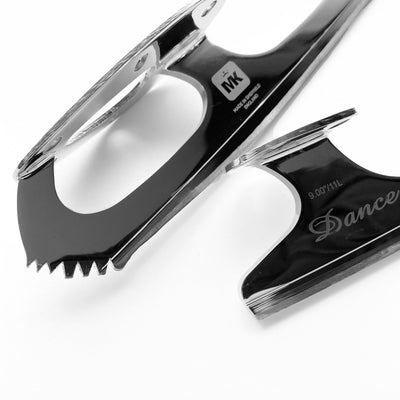
The bottom of a figure skate blade isn't flat. It's ground into a shallow groove, called the hollow, and the groove is what gives you two edges. Its depth is described as a radius, such as 1/2 inch, and a smaller number means a deeper hollow. Deeper hollows bite into the ice more, and shallower ones glide more freely.
| Deeper hollow (smaller number) | Shallower hollow (larger number) | |
|---|---|---|
| How it feels | More grip, edges bite into the ice | More glide, a little less grip |
| Often suits | Lighter skaters, or anyone who wants more bite | Heavier skaters, or anyone whose blades feel too grabby |
| If it's not right for you | Blades can feel sticky or grabby | Edges can feel slippery |
Most adult skaters don't need to think about hollow much. Find a setting that feels right with your sharpener, write it down, and ask for the same one every time so your blades feel the same after each sharpening. If they feel too grabby, ask for a little shallower next time, and if they feel slippery, a little deeper.
After a sharpening
Freshly sharpened blades often feel different for a while, usually grabbier than you're used to, because they've got back the bite that faded as the old edge wore down. Give yourself some easy skating to get used to them before you try anything big. If they still feel wrong after a session, or one edge grabs while the other slips, go back to your sharpener and describe what you're feeling.
Because of that adjustment, it helps to time sharpenings around big days. If you have a test or a competition coming up, sharpen early enough to get a few practice sessions on the new edges. New skates are a special case. New blades usually come with a factory finish rather than a proper edge, so they need sharpening, ideally once they're mounted, before you skate on them.
Making a sharpening last
A lot of edge damage happens off the ice. Wear hard guards whenever you walk anywhere other than the rink's rubber flooring, and watch for grit even there. Concrete, tile and outdoor ground can nick or dull a blade very quickly. Take the guards off right before you step onto the ice and put them back on as soon as you step off.
After skating, dry your blades properly with a towel, including the sides and around the screws, then put them in soft soakers rather than hard guards. Hard guards trap moisture against the steel, which causes rust. At home, take your skates out of the bag so they can air out. Our guide to guards and soakers explains the difference, and Skate Care 101 covers the rest of the routine.
If you need a set, we carry a CRS Cross guards, soakers and towel set. It's in our gift guide too, since it's an easy one for family to get right. Don't knock your blades together or let them rattle around loose in your bag, and check the mounting screws now and then. Our blade guide has more on the blades themselves, from rockers to when it's worth upgrading.
If you'd like everything for looking after new blades in one place, we've put together a Blade Care Kit on our Amazon storefront. It has the guards and soakers we'd pack first, plus smaller things like a blade towel and a hone that help keep your edges in good shape between sharpenings.
Heads up: this guide contains an Amazon affiliate link. If you buy through it, Adults Skate Too earns a small commission at no extra cost to you. Details.
This is general advice from adult skaters. Your sharpener sees your blades up close, so if their advice differs from this page, go with theirs.