
This glossary explains the figure skating gear words adult beginners hear first, from the parts of the boot and blade to fit words, blade specs like rocker and hollow, and the things in your skating bag. Each term gets a short, plain definition and a link to the guide that covers it in more detail.
Key takeaways
- A figure skate is a boot and a blade. Beginner skates usually come as a set, and later you can buy them separately and have the blade mounted.
- Stiffness ratings are set by each brand, so compare them within one brand and match them to the skating you do now.
- Rocker, toe pick and hollow are the three blade specs that change how a blade feels the most.
- Hard guards are for walking and soakers are for the bag. Never store skates in hard guards.
Skating gear comes with its own vocabulary, and a fitting or a trip to the sharpener can feel like a lesson in a new language. Your fitter mentions punching, your coach asks about your rocker, and the sharpener wants to know your hollow. This glossary explains those words in plain English, grouped the way you'll meet them.
It covers the words rather than the buying advice. For that, our guide to the best figure skates for adult beginners, our boot guide and our blade guide go into detail. Our glossary of common skating terms covers jumps, spins and footwork.
Parts of the boot
A figure skate boot is built to hold your foot and ankle firmly over the blade. These are the parts you'll hear named at a fitting.

Upper is the body of the boot, the part that wraps around your foot and ankle. It's built from layers of leather or synthetic material, and how it's built has a lot to do with how stiff and supportive the boot feels.
Tongue is the padded piece that runs up the front of the boot under the laces. It spreads the pressure of the laces and helps the boot fit snugly, and when it can't do that job, you can end up with lace bite.
Eyelets and hooks are what the laces run through. Eyelets are the small holes over your foot, and hooks are the open metal hooks near the top of the boot, where most skaters lace a little easier so they can bend their knees.
Heel counter is the firm cup at the back of the boot that holds your heel. In a boot that fits, your heel stays down in it when you bend your knees or rise onto your toes.
Sole and heel are the bottom of the boot. The blade is screwed into the sole under the ball of your foot and into the heel, the raised block under the back of the boot, which is often made of stacked leather or a lightweight composite.
Set or boot only describes how skates are sold. A set is a boot sold with a blade already mounted, which is how most beginner figure skates come. Boot only means the boot comes without a blade, so you choose one separately and have it mounted.
Fit, stiffness and break-in words
These are the words you'll hear while you're trying skates on and getting used to new ones. Our fitting guide walks through the whole process.
Stiffness or support rating is the number a brand gives a boot to show how much it resists your ankle bending. Each brand uses its own scale, usually somewhere between 10 and 100, so compare numbers within one brand rather than across brands. Our boot guide explains how to match stiffness to your level.
Overbooting means buying a boot that's stiffer than your skating needs. It's an easy mistake to make, because stiffer sounds better, but a boot that's too stiff makes it hard to bend your knees and ankles and slows your progress.
Skate size is the size on the boot, and it rarely matches your street shoe size. Figure skates usually run smaller than street shoes, by an amount that depends on the maker, so measure your feet and use each maker's own size chart. Width matters too, and makers fit differently, so a fitter may have you try more than one brand.
Heat molding means warming a boot so it can shape to your foot as it cools. Not every boot can be heat molded, and each maker has its own instructions, so it's a job for a fitter with the right equipment. It helps a boot that's close to the right size fit better, but it won't fix the wrong size.
Break-in is the time it takes a stiff new boot to soften and shape to your feet. How long it takes depends on the boot, how stiff it is and how often you skate, and some discomfort along the way is normal. Sharp or shooting pain isn't, and neither is numbness that doesn't go away when you loosen your laces.
Punching is when a fitter stretches one small area of a boot, such as over an ankle bone, to take the pressure off. It's the usual fix when the same spot keeps hurting after the first few sessions, and a fitter can sometimes heat mold just that spot instead.
Lace bite is soreness at the front of your ankle, where the tongue and laces press as your ankle bends. Easing the lacing at the bend and adding padding under the tongue often helps, and your fitter can take a look if it keeps happening.
Gel sleeves and insoles are add-ons that help a boot fit your foot. Gel sleeves slip over the ankle or heel inside the boot to cushion a pressure point, and insoles change the support under your arch, so ask your fitter which suits you. If you'd like gel sleeves, we carry CRS Cross ankle gel sleeves.
Parts of the blade
A figure skating blade looks simple, but every part has a name, and you'll hear most of them at the sharpener or the pro shop. Our blade guide covers the same parts in more depth.

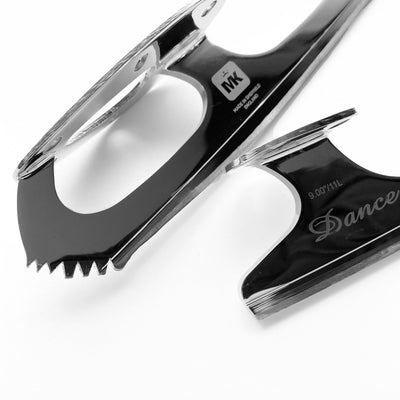
Runner is the long strip of steel that touches the ice. Its bottom is ground with a shallow groove, the hollow, which gives the runner its two edges.
Edges are the two sharp sides along the bottom of the runner. The inside edge is on the big toe side of your foot and the outside edge is on the little toe side, and you skate on one edge at a time. Our guide to inside and outside edges explains how to use them.
Toe pick is the set of jagged teeth at the front of the blade. Skaters use it to take off for toe jumps like the toe loop and flip and for some spins and pivots, but not for stopping. If you hear a scratch at the end of a push, it's usually the toe pick catching because the push came off the front of the blade.
Plates are the flat parts at the top of the blade that sit against the boot. There's one under the ball of your foot, often called the sole plate, and one under the heel, and the blade is screwed to the boot through holes in each.
Stanchions are the posts that connect the runner to the plates. Taller stanchions lift the boot further from the ice, which gives more clearance on deep edges, and shorter ones keep the boot closer to the ice.
Tail is the back end of the blade, behind the heel of the boot. Freestyle blades have longer tails for support on landings, and dance blades have shorter ones so you don't trip on them in close footwork.
Blade specs: rocker, toe pick and hollow
Three specs change how a blade feels more than anything else: the rocker, the style of toe pick and the hollow. The table sums them up, and the definitions below explain each one.
| Spec | Option | How it feels |
|---|---|---|
| Rocker | 8 ft | A flatter curve with more blade on the ice, so it's steadier on landings and glides and forgiving for newer skaters |
| Rocker | 7 ft | More curve with less blade on the ice, so turns and pivots come quicker, but it asks for more precision |
| Toe pick | Cross-cut | Angled, criss-cross teeth that grip more smoothly and forgive more |
| Toe pick | Straight-cut | Upright teeth that dig in more, for strong toe jump takeoffs |
| Hollow | Deeper (smaller number) | More grip, because the edges bite into the ice more |
| Hollow | Shallower (larger number) | More glide, with a little less grip |
Rocker is the curve along the bottom of the blade from toe to tail, described by the size of the circle it would make, usually 7 ft or 8 ft. A bigger circle makes a flatter curve, so more blade touches the ice. Our guide to rockers explains how each one feels.
Spin rocker, or secondary rocker, is the more sharply curved section under the ball of your foot, just behind the toe pick. It's the part you spin on, and a more pronounced spin rocker makes the sweet spot easier to find. Two blades with the same main rocker can feel very different because of it.
Straight-cut and cross-cut are the two main styles of toe pick. Straight-cut picks have upright teeth that dig in more, and cross-cut picks have angled teeth that grip more smoothly and are more forgiving for newer skaters. Beginner blades usually have smaller picks, which are less likely to snag.
Hollow, or radius of hollow (ROH), is the shallow groove ground into the bottom of the blade that creates its two edges. Its depth is given as a radius, such as 1/2 inch, and a smaller number means a deeper hollow with more bite, while a larger number means a shallower hollow with more glide. Once you find a hollow you like, ask your sharpener for the same one every time.
Side-honed blades have sides that angle inward toward the edges instead of running straight down. That cuts drag and weight, and you'll find it on advanced freestyle blades such as the John Wilson Gold Seal. Beginners don't need it.
Parabolic blades are slightly thinner in the middle and thicker at the toe and heel, a subtle hourglass shape meant to help you stay centered over the blade. They sharpen like a normal blade, and some skaters notice the difference more than others.
Lightweight blades pair a steel runner with a lighter body, such as carbon fiber or aluminum, to save weight. John Wilson's Revolution and Phoenix blades are examples, and our Pattern 99 review explains how its versions differ.
Mounting and sharpening words
Once you own skates, a skate technician mounts and sharpens your blades, and these are the words you'll swap with them. Our sharpening guide covers when and how often to go.
Mounting means fixing the blade to the boot with screws through the plates. Where the blade sits under the boot, called its alignment, affects your balance and your edges, and poor alignment can spoil even a good blade. It's a job for a skate technician, not a DIY project, and sets come with the blade already mounted.
Temporary mount is when a technician fixes a new blade with only some of its screws at first. You skate on it for a while, the technician adjusts the position if it needs it, and then the blade is fixed in place for good. Ask when they'd like you to come back.
Sharpening grinds the bottom of the blade to restore the hollow and the edges. There's no official schedule, so watch for edges that slip and stops that skid, and keep a rough count of your hours to learn how your own blades wear.
Factory finish is the edge new blades come with, and it isn't a proper skating edge. New blades usually need sharpening before you skate on them, ideally once they're mounted.
Level edges means both edges of a blade are the same height after sharpening. Uneven edges can make one edge feel grabby and the other slippery, so it's fair to ask your sharpener to check.
Fingernail test is a quick way to check sharpness at home. Gently drag a fingernail across the edge, from side to side, and a sharp edge catches a little while a dull one lets the nail slide straight off. Never run a finger along the edge.
In your skating bag
A few small things keep your blades and boots in good shape between sessions. Our skating bag checklist has the full list.
Hard guards are plastic or rubber covers that clip over the blades so you can walk off the ice without nicking or dulling the edges. Take them off right before you step onto the ice and put them back on as soon as you step off. Never store your skates in them, because they trap moisture against the steel.
Soakers are soft fabric covers that go on once you've dried your blades with a towel. They soak up the leftover moisture and protect the edges in your bag, and at home you take them off so the blades can finish drying. Our guide to guards and soakers explains the routine, and we carry a CRS Cross guards, soakers and towel set.
Rust is what happens when water is left on the steel, and it shows up as spots along the blade. Drying your blades after every session and never storing them in hard guards prevents most of it, and a badly rusted edge needs a sharpener.
Spinner is a small off-ice board or disc you spin on at home to practice spin positions and rotation. It's handy once you're working on spins, and our guide to off-ice spinners compares the types.
Sources
This glossary follows our own fitting, sharpening, boot, blade and guards guides, so the definitions here match them. The boot parts follow Riedell's guide to skate anatomy, and the notes on stanchions and spin rockers follow John Wilson's published blade specs, both read through search excerpts in October 2026.
- Riedell Skates, From Boot to Blade: Your Guide to Ice Skate Anatomy (Riedell ice blog): the parts of the boot.
- John Wilson Blades, blade comparison chart and Gold Seal page: spin rockers and what stanchion height does.
- Adults Skate Too guides to fitting, sharpening, boots, blades, rockers and guards and soakers: every fit, stiffness, blade, sharpening and care definition.