Ice Skating Terms Explained (Like You're Not at the Olympics)
A glossary of figure skating terms that actually makes sense — from toe picks to triple axels.
If you've ever heard someone yell "that was a flutz!" across the rink and thought, "excuse me, a what now?" — this post is for you.
Whether you're new to skating, returning as an adult, or still trying to remember which edge you're supposed to jump from, here's a glossary of figure skating terms that actually makes sense. No judges' panel required.
Basic Ice Skating Terms Every Beginner Should Know
Toe Pick
The jagged teeth at the front of your figure skating blade. You use these to launch jumps, grip during spins, and — occasionally — catch a rut and fall dramatically mid-crossover. It's a rite of passage. (The movie reference? Also a rite of passage.)
Edges
Your blades have two sides: the inside edge (closer to your body) and the outside edge (facing away). Learning to control your edges is what separates a beginner from a real skater. Fake it 'til your glide is silent.
Crossovers
That smooth footwork where one skate crosses over the other while skating a curve. Crossovers help you gain speed, look polished, and stress-test your balance. You can do them forward or backward — and they usually feel wrong before they feel right.
Stroking
The fundamental push-and-glide motion that moves you across the ice. Good stroking uses deep edges and smooth knee bend. It sounds basic, but powerful stroking is the foundation of everything else.
Three Turn
A one-foot turn where you rotate from forward to backward (or backward to forward) by shifting your weight over your edge. It traces a "3" shape on the ice — hence the name. You'll do approximately ten thousand of these before they feel natural.
Mohawk
A two-foot turn where you shift from one foot to the other while changing direction. Unlike a three turn, both feet touch the ice during the transition. Common in footwork sequences and choreography.
Falling (Yes, It's a Term)
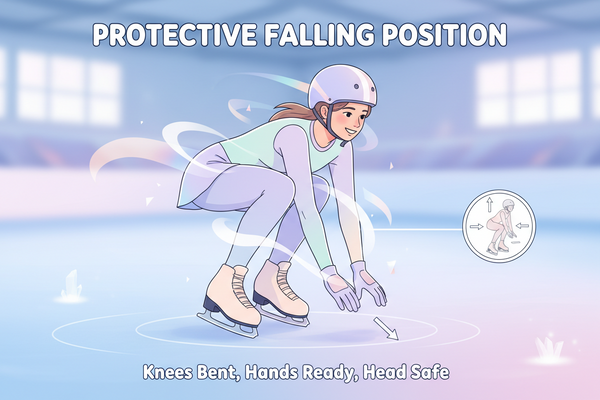
Officially, a fall is when your body — butt, hands, knees, or any other body part — hits the ice. Judges deduct one point per fall in competition. Around here, we call it progress.
Figure Skating Jumps Explained
All figure skating jumps fall into two categories: edge jumps (takeoff from the blade's edge only) and toe jumps (toe pick assists the takeoff). For a deeper dive into each one, check out our full guide to every figure skating jump explained.
Waltz Jump
The first real jump most skaters learn. Half a rotation, forward takeoff, backward landing. It's the gateway drug to everything else. Still counts. Still majestic.
Axel
The chaos jump. The axel is the only jump that takes off going forward, which means a single axel is actually 1.5 rotations. You launch forward, spin one and a half times, and land backward on one foot. Every skater's favorite trauma milestone. A double axel is 2.5 rotations. A triple is 3.5. And the quad axel — 4.5 rotations — has been landed in competition exactly once (by Ilia Malinin in 2022).
Salchow
An edge jump that takes off from a back inside edge with a scooping leg swing. Named after Swedish skater Ulrich Salchow. Pronounced "SAL-kow," not "sal-CHOW." You'll love this jump or you'll hate it. Probably both.
Toe Loop
A toe-assisted jump that takes off from a back outside edge. It's the most common second jump in combinations because it naturally follows the landing edge of other jumps. Think of it as the reliable sidekick.
Loop
An edge jump that takes off and lands on the same back outside edge — no toe pick, no free leg swing. The loop is weirdly simple in theory and weirdly hard in practice. Your thighs will have opinions.
Flip
A toe jump that takes off from a back inside edge. The skater reaches back with their free foot, taps the toe pick, and launches. Often confused with the Lutz — but the edge is the key difference.
Lutz
A toe jump that takes off from a back outside edge. The Lutz is the outside-edge diva of jumps — harder than the flip because you're working against your body's natural rotation. When a skater accidentally takes off from the inside edge instead, that's called a flutz (and yes, the judges will catch it).
Combination Jump
Two or more jumps performed one right after the other without steps or turns in between. The second jump is almost always a toe loop or loop, because those take off from the natural landing edge. A triple Lutz–triple toe loop combination is one of the most common high-value combos you'll see in competition.
Figure Skating Spins and Positions
Scratch Spin (Upright Spin)
The classic upright spin that starts slow and speeds up as you pull your arms and legs in — like a human Beyblade. The tighter you pull, the faster you go. It's the first spin most skaters learn, and it never stops being satisfying.
Camel Spin
A spin with one leg extended behind you at hip level or higher, like an airplane. Requires solid core strength and some delulu energy to hold the position while rotating.
Sit Spin
A spin performed in a deep squat position on one leg, with the free leg extended. Quads burning, audience impressed, knees questionable. Your thighs will remember this one.
Layback Spin
An upright spin where the skater arches backward. It looks beautiful and feels like your spine is filing a formal complaint.
Biellmann Spin
That extreme back-bending spin where you pull your free leg up over your head while rotating. Named after Swiss skater Denise Biellmann. Requires elite flexibility. (Shoutout to Yuzuru Hanyu, who made this look effortless.)
Combination Spin
A spin that includes at least two different positions — like a camel that transitions into a sit spin and then an upright. Higher levels require more position changes, difficult variations, and edge changes. These are where spin levels really come into play.
Flying Spin
A spin entry where the skater jumps into the air before landing in a spin position. A flying camel, flying sit, or death drop all qualify. Extra style points if you don't bail on the landing.
Figure Skating Program Structure and Components
If you're watching skating at the Olympics or any ISU competition, you'll hear a lot of terms about program structure. Here's what they mean.
Short Program
The first of two programs in singles and pairs competition. It's about 2 minutes and 40 seconds long and includes a required set of elements — a specific jump combination, a solo jump, a jump with an axel, spins, and a step sequence. There's no room for error. Miss a required element and you can't make it up.
Free Skate (Long Program)
The second and longer program — roughly 4 minutes for women, 4.5 for men and pairs. More jumps, more spins, more creative freedom, and more opportunities to either shine or spiral. This is where the real drama happens.
Rhythm Dance
The short segment for ice dance (replaces the short program). Each season has a prescribed rhythm or theme that all dance teams must follow. Think of it as: same assignment, different interpretation.
Free Dance
The longer ice dance segment. Unrestricted theme and music, with required elements including lifts, twizzles, step sequences, and dance spins. No jumps allowed — it's all edges, precision, and chemistry.
Transitions
The moves between jumps and spins — steps, turns, twizzles, spread eagles — that connect one element to the next. Good transitions make a program look seamless. Bad transitions make it look like the skater is just skating in circles and then jumping. Judges notice the difference, and it directly affects the program component score.
Choreographic Sequence
A required element in the free skate where skaters show off their artistry — spirals, Ina Bauers, hydroblading, spread eagles, whatever makes their coach cry (in a good way). It earns a fixed base value and GOE, but more importantly, it's where personality shines through.
Step Sequence
A required element featuring a sequence of turns, steps, and footwork that covers the full ice surface. Think of it as a dance break — complex patterns, deep edges, and musicality. It's evaluated for difficulty (levels 1–4) and quality (GOE).
Program Components (PCS)
The "artistic" side of the score. Judges evaluate five components: Skating Skills, Transitions, Performance, Composition, and Interpretation of the Music. You can land every jump and still lose on components if your skating looks flat. Eye contact mid-spiral? That helps. Read more in our full scoring breakdown.
Figure Skating Scoring Terms Explained
The International Judging System (IJS) replaced the old 6.0 system in 2004, and it's both more transparent and more confusing. Here are the key terms you'll see on every scoresheet. For the full deep dive, check out our guide to how figure skating scoring works.
📊 The Scoring Formula
Total Segment Score (TSS) = Total Element Score (TES) + Program Component Score (PCS) − Deductions
Your final competition placement is based on the combined TSS of your short program and free skate.
Base Value
Every element — jump, spin, step sequence, lift — has a predetermined base value based on its difficulty. A triple axel has a high base value (8.00 points). A waltz jump… not so much. But still iconic.
Grade of Execution (GOE)
A +5 to -5 score each judge assigns based on how well you executed an element. Clean landing with good height and flow? Bonus points. Fell on your face? Welcome to negative town. The GOE is added to (or subtracted from) the base value.
Total Element Score (TES)
The sum of all your jump, spin, step sequence, and other element scores (base value + GOE for each). This is the technical side of your scorecard.
Program Component Score (PCS)
Your artistry score. Judges rate your Skating Skills, Transitions, Performance, Composition, and Interpretation of the Music. You can literally feel this score go up if you make eye contact with the judges mid-spiral. See our quick reference guide to good scores.
Total Segment Score (TSS)
TES + PCS – any deductions = your total score for that program. Your final competition placement is based on the combined total of your short program and free skate segment scores.
Deductions
Points subtracted from your total for things like falls (-1 per fall), time violations, costume violations, or illegal elements. Yes, there are rules about costumes. No, you can't wear a cape.
Protocol (Score Sheet)
The detailed breakdown of every element, its base value, GOE, component scores, and deductions. If you want to nerd out after watching a competition, the protocol is where the real story lives.
Pairs and Ice Dance Specific Terms
Throw Jump
A pairs element where one partner literally launches the other into the air for a multi-rotation jump. The thrown skater lands solo. It's as dramatic as it sounds. Casual.
Twist Lift
The man throws his partner into the air, she rotates, and he catches her by the waist before she lands. It happens fast and it's terrifying every single time.
Death Spiral
A pairs spin where one skater pivots in place while their partner spirals around them with their body nearly parallel to the ice, held by one hand. It's called a death spiral. Enough said.
Side-by-Side Elements
When both partners perform the same jump or spin simultaneously, in sync. Unison is everything here — if one partner is a half-rotation off, it shows.
Lift
A pairs or ice dance element where one skater lifts the other. Pairs lifts go overhead. Ice dance lifts cannot go above the shoulder. Both require strength, trust, and adrenaline.
Twizzle
A multi-rotation one-foot turn that travels across the ice. Ice dancers perform synchronized twizzles as a required element — and they make it look effortless. It is not.
Bonus Terms That'll Make You Sound Like You Know What You're Talking About
Flutz
When a skater attempts a Lutz (which should take off from a back outside edge) but actually takes off from the inside edge — making it essentially a mislabeled flip. Judges mark it, commentators call it out, and skaters dread it. It's one of the most common edge call errors in the sport.
Under-Rotation
When a skater doesn't complete the full rotation of a jump before landing. A quarter-turn short gets marked with a "q" (and earns reduced GOE). More than a quarter short gets downgraded — meaning a triple gets scored as a double. Painful.
Backloading
Placing your hardest jumps in the second half of the program to earn a 10% bonus on base value. It's strategic, it's risky, and it's how top skaters maximize their scores.
Ina Bauer
A two-foot gliding move where the skater's feet face opposite directions — one forward, one backward — with a deep knee bend. Often performed with a dramatic back arch. Gorgeous when done well. Often seen in choreographic sequences.
Spiral
A gliding position on one foot with the free leg extended behind (usually at or above hip height). Spirals used to be required elements in women's programs and are now commonly seen in choreographic sequences. Flexibility and balance are everything here.
Hydroblading
A low-to-the-ice move where the skater glides on a deep edge with their body nearly horizontal to the surface. Dramatic, impressive, and a guaranteed crowd-pleaser in any choreographic sequence.
Spread Eagle
Gliding on two feet with toes pointed outward in opposite directions — either on inside or outside edges. It's a great transition move and looks particularly dramatic when used as a setup for a jump.
Zayak Rule
An ISU rule that limits how many times you can repeat the same jump in a program. Basically, you can only do a triple (or quad) jump twice — and one of those must be in a combination or sequence. Named after Elaine Zayak, who once loaded her program with six triple toe loops. Legend. Read more about it in our jump placement strategy guide.
Kiss and Cry
The bench area where skaters and coaches sit after performing while they wait for their scores. Named for the emotional range you'll witness there — from tears of joy to tears of "I can't believe I fell on that flip."
Got a skating term you want us to explain next? Slide into our DMs or drop it in the AST community group. We gotchu. 💙