How Do Figure Skaters Decide Where to Put Jumps?
The strategic chess match hiding inside every skating program and why it matters for scores
If you've ever watched a figure skating program and thought "that looked random," think again. Every element in a competitive program (especially jumps) is placed with surgical precision. Program layout is one of the most strategic parts of competitive figure skating, and it can make or break a skater's score.
Let's break down how skaters and their coaches decide where jumps go, and why placement matters so much under the current scoring system.
The Scoring System: A Quick Primer
Figure skating is judged under the International Judging System (IJS), sometimes called the "Code of Points." Every element a skater performs (jumps, spins, footwork) receives a base value. Jumps are the biggest point-earners, so optimizing placement is where the chess match begins.
But here's where it gets interesting: base value isn't the whole story. Judges also assign a Grade of Execution (GOE) ranging from -5 to +5 for each element, adjusting scores based on quality. Placement strategy isn't just about what jumps you do; it's about setting yourself up to do them well.
The Back-Half Bonus: The Biggest Strategic Factor
This rule has evolved significantly. Historically, any jump executed in the second half received a 10% bonus. However, starting in the 2018-19 season, the ISU restricted this bonus: only the last jumping pass in the short program and last three jumping passes in the free skate may earn the bonus when performed in the second half. This change was made to prevent excessive "backloading" of difficult elements.
That might not sound like much, but at the elite level, those extra points add up fast. Under the current (2018-onward) rules, a triple Axel (worth 8.00) would earn the 10% bonus only if it's placed as one of the last three jumping passes in the second half. A quad toe loop (9.50) would become 10.45 under the same conditions. The bonus opportunity creates a significant strategic incentive.
This is why elite skaters still try to place important jumps late in the program (within the restricted bonus windows). It's a calculated risk: they're attempting demanding elements when fatigued, but the math still rewards success. Skaters who can execute high-value jumps cleanly under these conditions gain a significant scoring edge.
The Well-Balanced Program Rules
Skaters can't just throw jumps in wherever they want. The ISU (International Skating Union) has strict "well-balanced program" requirements that dictate:
- How many jumps can be attempted (7 jump elements in the free skate for senior singles, 3 in the short program)
- How many combinations and sequences are allowed
- Repetition limits: you can only repeat two different triple or quad jumps in the free skate, and any repeated jump must be in a combination or sequence
- Required elements: the short program has specific required elements (for example, a double or triple Axel)
These rules force skaters to be strategic. You can't just do seven quad jumps. You have to plan a diverse set of elements that maximizes your total base value while staying within the rules.
Jump Order: Fatigue vs. Confidence
Beyond the rules, there's a very human element to jump placement: how your body and your nerves behave during a four-minute program.
Most skaters place their most difficult or nerve-wracking jump early in the program (often as their opening element). Why? Because they're freshest physically and want to get the scary one out of the way. Landing your biggest jump right out of the gate builds confidence for the rest of the program.
The bonus rules create a calculated tension: do you place your hardest jumps early when fresh, or risk placing them later in eligible bonus windows? Elite skaters with exceptional stamina (like Nathan Chen and Ilia Malinin) push more technical content toward the second half. Skaters building consistency might front-load to secure landings.
Combinations: Placement Within the Program and Within the Music
Jump combinations (two or three jumps connected without a step in between) are worth more than solo jumps, so where you place them matters too.
Smart coaches consider:
- Strategically placing combinations to include them in the restricted bonus windows
- Pairing a big jump with a reliable second jump: the triple toe loop and double toe loop are common "add-on" jumps because they're consistent and accessible off most landings
- Musical timing: ideally, combinations land on musical accents for maximum GOE impact
Transitions and GOE: It's Not Just About Landing
One of the biggest factors in where jumps are placed is what surrounds them. Under the current system, judges are looking for:
- Difficult entries into jumps (steps, turns, or changes of edge right before takeoff)
- Difficult exits out of jumps (moving into a spin, a spread eagle, or other transitional movement)
- Speed and flow before and after the jump
Skaters and choreographers work together to place jumps where they can build in transitions naturally. A jump after long crossovers scores lower on GOE than one launched from a back counter turn or spread eagle.
This is also why you'll sometimes see a skater take what looks like a weird, winding path across the ice before a jump. They're not lost; they're loading up transition difficulty to boost their GOE.
Ice Coverage: Judges Are Watching Where You Skate
Another factor in placement: ice coverage. Judges and technical specialists notice if a skater does all their jumps in one corner of the rink. Programs are expected to use the full ice surface, and element placement is mapped out to ensure jumps happen in different areas.
Coaches will literally diagram programs on paper or on rink-shaped templates, plotting where each element happens to make sure the skater covers the ice evenly and doesn't cluster elements in one spot.
The Zayak Rule: Why You Can't Just Repeat Your Best Jump
Named after Elaine Zayak, who landed six triple jumps (four triple toe loops) to win the 1982 World Championships, the "Zayak Rule" limits how many times you can repeat a jump. In the free skate, only two triple or quad jumps can be repeated, and the repeated jump must be done in a combination or sequence.
This rule forces variety and directly impacts layout strategy. If your best jump is a triple Lutz, you can do it twice, but the second one has to be in a combination. That affects where you place both of them.
Putting It All Together: What a Typical Layout Looks Like
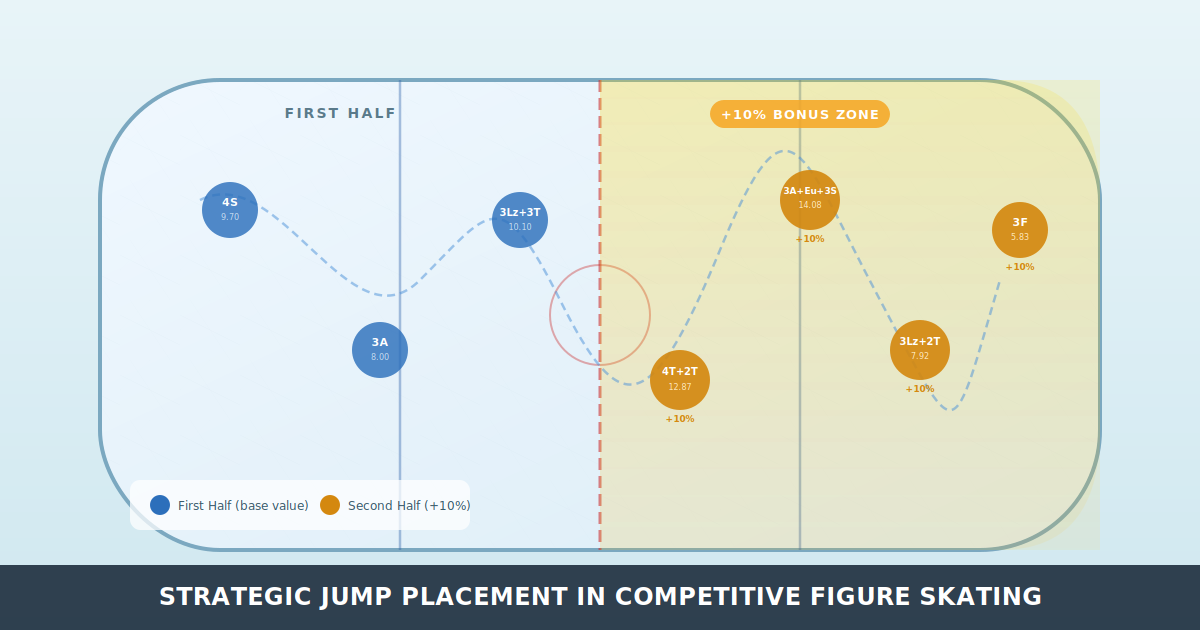
Here's a simplified example of how a competitive free skate layout might look:
Sample Free Skate Layout
First Half:
1. Quad Salchow: big opener, get it done while fresh
2. Triple Axel: another tough one, best to do early
3. Triple Lutz + triple toe loop combination
Second Half (10% bonus on all):
4. Quad toe loop + double toe loop combination: hardest combo, maximizing bonus
5. Triple Axel + euler + triple Salchow: three-jump combo in the bonus half
6. Triple Lutz + double toe loop: repeated jump must be in a combo (Zayak rule)
7. Triple flip
Every layout goes through constant revision. Coaches adjust week to week based on what's consistent in practice, what the competition looks like, and how the skater is feeling physically.
Why This Matters for Fans
Understanding jump placement turns skating from passive to active viewing. When you see a skater land a quad in the final minute, it's not just impressive athletically: it represents a calculated risk worth real points. When skaters shift jumps between program halves, it's a strategic choice between consistency and score optimization.
It's chess on ice. And honestly? That's what makes it so compelling to watch.
Frequently Asked Questions
The back-half bonus is a 10% point increase applied to certain jumping passes executed in the second half of the program. Currently, only the last jumping pass in the short program and the last three jumping passes in the free skate can earn this bonus. This rule encourages strategic placement of difficult jumps and affects how coaches design competitive programs.
Skaters place jumps in the second half to earn the 10% back-half bonus, which significantly increases point values for difficult elements. For example, a 9.50 quad toe loop becomes 10.45 with the bonus. However, this is a calculated risk because skaters are fatigued at the end of a four-minute program, making landings more difficult. Elite skaters balance this risk-reward, while developing skaters may front-load jumps for consistency.
The Zayak Rule limits how many times a skater can repeat the same triple or quad jump in the free skate to two different jumps total. Any repeated jump must be performed within a combination or sequence. This rule was established after Elaine Zayak won the 1982 World Championships with four triple toe loops, and it forces variety in program content and strategic placement decisions.
In the free skate for senior singles, skaters can attempt 7 jumping elements. In the short program, only 3 jumps are allowed. The ISU's well-balanced program rules also mandate specific types of elements and limit repetition. These requirements force coaches to strategically plan diverse jump layouts that maximize total base value while following all regulations.
Grade of Execution (GOE) is a score from -5 to +5 assigned by judges to each technical element (jumps, spins, footwork), modifying the base value based on quality and execution. Judges consider factors like difficult entries and exits, speed, flow, and overall presentation. This is why jump placement matters: skaters position jumps after choreography that builds in transition difficulty to maximize their GOE.
Coaches strategically plan jump placement by mapping out programs on paper or rink templates, considering the back-half bonus window, Zayak rule restrictions, ice coverage, musical phrasing, and transitions. They balance difficult jumps early (when fresh) against placing high-value jumps late (for bonus points). Program layouts are constantly revised based on what the skater can execute consistently in practice.
Ice coverage refers to how evenly a skater uses the full surface of the ice during a program. Judges and technical specialists notice if elements cluster in one area. Good program design spreads jumps, spins, and footwork across the rink so the skater travels the full length and width. This is considered part of program quality and can influence scoring on presentation components.
Yes, a jump combination can include two or three jumps performed consecutively without a step in between. Three-jump combinations are worth more base value than solo jumps or two-jump combinations. Coaches strategically place combinations (especially in the second-half bonus window) to maximize point value while respecting Zayak rule restrictions on repeated jumps.
A jump combination consists of consecutive jumps with no steps between them, landing on one foot and immediately taking off for the next jump. A sequence involves jumps with a step, turn, or other skating movement between them. Both can include multiple jumps, and the base values differ. Strategic placement of combinations (which are worth more) in bonus windows is a key coaching decision.
Transitions significantly affect GOE (Grade of Execution) because judges reward difficult entries (steps, turns, or edge changes before the jump) and difficult exits (movements after landing like spread eagles or spins). This is why coaches choreograph specific skating patterns before and after jumps. A jump launched from a back counter turn scores higher on GOE than one after simple crossovers, making strategic placement and choreography essential.