13 Tips for Adult Beginner Figure Skaters
Technique, gear, mindset, etiquette, and how to actually enjoy the learning process from your first session to confident skating.
Taking up figure skating as an adult can feel equal parts exciting and intimidating. You might be wondering if you'll be the only beginner over 20 at the rink, or worrying that you "should have started as a kid." You're not alone, and it's never too late. Adult skaters bring a unique enthusiasm, patience, and self-awareness to the ice that kids don't have.
These 13 tips cover the practical stuff: technique, gear, how to fall, how to stop, plus the mindset and community side that makes adult skating genuinely enjoyable.
Warm Up and Stretch Before Skating
Don't skip this. Adult bodies need more prep than a 10-year-old's. We're coming from desks, cars, and errands with tight muscles and cold joints. Five to ten minutes of dynamic movement before stepping on the ice makes a real difference in how your body responds.
A quick jog in place, some jumping jacks, leg swings, and ankle circles get your blood flowing and joints loose. You'll skate with better range of motion, less risk of strain, and a clearer head. It also gives you a moment to mentally shift from "work brain" to "skating brain," which matters more than most people realize.
Invest in Proper Skates (Get Fitted)
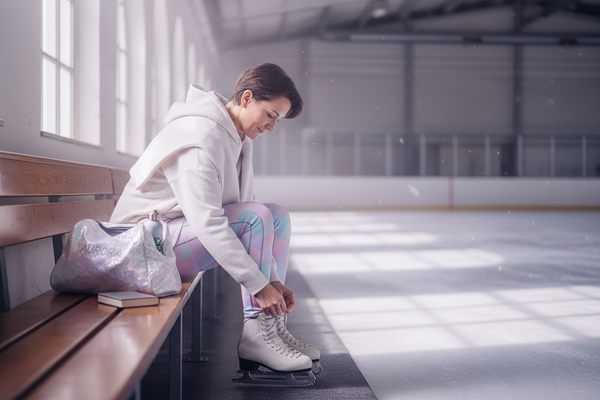
Rental skates are fine for your first handful of sessions. But if you're committed to learning, your own properly fitted boots and blades are one of the biggest upgrades you can make. The difference in comfort, edge feel, and ankle support is dramatic and directly affects how fast you progress.
Fit is everything. Skates that are too loose kill your edge control; too tight and you'll be in pain before the warm-up lap is over. Visit a specialty skate shop (not a sporting goods store) for a professional fitting. A good fitter matches your foot shape, arch, and width to the right boot and stiffness level for your size and skill level. It's an investment that prevents injury and makes every session more productive.
💡 On Stiffness
Adults often need a slightly stiffer boot than a child at the same skill level because more body weight needs more support. But don't go too stiff. An overly rigid boot restricts ankle movement and makes it harder to learn proper knee bend. Your fitter can guide you to the right balance.
Dress for Comfort and Mobility
Fitted, flexible layers. That's the formula. Leggings or athletic pants, a moisture-wicking base layer, and a light jacket or fleece you can unzip or remove as you warm up. Skip jeans (they restrict movement and absorb moisture), skip cotton (it stays wet and gets cold), and skip anything bulky that hides your posture from your coach.
Gloves are non-negotiable: they protect your fingers when you fall and keep your hands warm while you're standing still. Thin socks, one pair. And whatever you wear, make sure you can bend, lunge, and extend your leg without your clothing getting in the way.
Check Your Posture: Knees Bent, Head Up
Good skating starts with good posture, and your instinct is going to fight you here. When you're nervous, your body wants to stand up straight and stiff, or worse, lean back away from danger. Both make you more likely to fall.
The ideal skating stance is a gentle athletic crouch: knees bent, weight over the balls of your feet, chest up, shoulders relaxed, head looking forward. Bend your knees more than you think you need. There's almost no such thing as too much knee bend for a beginner. And don't stare at your feet. Looking down shifts your weight over your toe picks and throws off your balance. Eyes on the horizon, trust your edges.
🎯 The Posture Check
If you can't see your knees past your toes, you're not bending enough. If you're looking at the ice instead of across the rink, your head is too far down. Think skiing or biking: soft knees, slight forward tilt, not rigid.
Find Your Balance (Let Go of the Wall)
Wobbly legs are completely normal. Using the boards for support when you first step on is fine. Just hold them lightly; don't death-grip the rail. The wall is a tool, not a crutch. As you gain confidence, let go for a few seconds at a time. Then a few more. Then a whole glide.
You won't learn to balance while clinging to the barrier. Balance only develops when your body has to figure it out for itself. Practice standing on two feet, shifting your weight side to side, and gliding short distances. Be courteous: don't park yourself at the boards for half the session. Do a few tries, then push off and circulate, checking for oncoming skaters before you move.
Don't Fear Falling: Learn to Fall Safely
Let's address the elephant in the rink. As an adult, falling is scarier. We're not made of rubber, we have farther to drop, and our recovery time is measured in days, not hours. But every skater falls, including the ones on TV. What separates a scary fall from a manageable one is technique.
How to fall safely: If you feel yourself going, bend your knees immediately and try to go down to the side. Land on the fleshy part of your thigh and rear, not your tailbone, not straight onto your knees, and not on outstretched hands. Tuck your chin to protect your head. Let yourself crumple rather than fighting it.
You can practice falling at home on a soft surface to build the muscle memory. Protective gear—gloves, knee pads, padded shorts, a helmet—takes the edge off the fear by cushioning the impact. The more you fall safely, the less scary it becomes. Bruises heal. The regret of never trying doesn't.
⚠️ Falling Mistakes to Avoid
Don't stick your arms out straight to catch yourself. That's the #1 cause of wrist injuries. Don't lean back and fall on your tailbone. Don't try to stay upright when you've already lost your balance. The later you commit to the fall, the harder you land. Go down early, go down soft, go down to the side.
Master the Basics: Gliding, Stroking, and Swizzles
Fancy jumps and spins can wait. As a beginner, your time is best spent on the movements that build your foundation: gliding on two feet, pushing off into forward strides (stroking), and swizzles. Swizzles are the hourglass-shaped pumping motion that teaches you to use your edges and generate momentum without lifting your feet.
These feel basic because they are basic. They're also the foundation for everything else you'll ever do on ice. Strong forward skating with good form—push off, glide, feel your edges—builds the leg strength, balance, and blade awareness that make every skill after this possible. Coaches will sometimes have skaters do entire sessions of just stroking and swizzles with deep knee bends. It's a workout, and it works.
Practice Stopping (Early and Often)
If you can move on the ice, you need to be able to stop. This is a safety skill, not an optional one. Many beginners put it off because it feels harder than gliding. Start practicing as soon as you can move at any speed.
The snowplow stop is where most beginners start: skate forward slowly, angle your toes inward (like making a pizza slice shape), and gently press the inside edges of your blades into the ice. The friction creates drag and slows you down. Start with light pressure. Too much force too suddenly and you'll lose your balance. Increase gradually as you develop a feel for how much it takes.
Make stopping practice a regular part of every session. You want to be able to halt confidently enough to avoid collisions and control your speed on crowded ice. As you improve, you can learn T-stops and hockey stops, but the snowplow is your essential starting tool.
Respect Rink Etiquette
When you're focused on not falling, it's easy to forget that 30 other people are sharing the ice with you. A few basic habits keep everyone safe and the session enjoyable.
- Skate with the flow: Follow the direction of traffic (usually counter-clockwise) unless you're in a lesson doing something specific.
- Keep moving: Don't camp out in one spot, especially the center or along the boards. Skating is a moving sport: circulate.
- Look before you move: Check over your shoulder before starting, stopping, or changing direction. Think of it like checking mirrors while driving.
- Head up, eyes forward: Scan ahead to anticipate and avoid collisions.
- Be courteous: Give right of way to those in a lesson or program, and don't monopolize practice space.
Defensive skating is the name of the game: assume others might not see you, so it's on you to see them.
Take Lessons or Find a Coach
You can teach yourself a lot by watching videos and grinding out practice sessions. But nothing beats professional instruction for building a solid foundation. A coach catches the technique issues you can't feel yourself: the slight lean you didn't notice, the push that's using the wrong edge, the arm position that's throwing off your spin.
Adult learn-to-skate classes are welcoming, designed for beginners, and full of other adults who share your excitement and nerves. The structured environment introduces skills in a safe, logical order and keeps you progressing without jumping ahead into bad habits. Many rinks offer adult-only classes and sessions, which can be less intimidating than skating alongside 7-year-olds who are already landing jumps.
💡 Group vs Private
Group classes are great for beginners: they're social, affordable, and cover fundamentals in a structured format. Private lessons become more valuable once you have specific skills to work on or want focused feedback. Many adult skaters do both: group class for structure, occasional privates for problem-solving.
Be Patient: Go at Your Own Pace
This is the hardest tip to follow and the most important one to hear. Progress will feel slow. It will definitely feel slower than the 8-year-olds zipping past you who seem to pick up everything in one session. Don't let it get to you. Your journey is your own.
Adults advance at a different pace than children, and that's completely fine. With consistent practice and the right guidance, you will improve. It just takes time. Don't play the comparison game. There's no race, no deadline, and no one keeping score except you. Consistency matters more than speed of progression. Even if you feel like you're learning slowly, the cumulative effect of showing up session after session adds up in ways that surprise you.
Celebrate the small wins: your first proper stop, your first time letting go of the wall, your first backward crossover. Those are real achievements.
🧠 A Perspective Shift
One of the advantages of learning as an adult is that you get to decide your goals. Whether you want to master a simple lap around the rink or work toward a test or competition, it's your call, not a parent's or a program schedule's. That freedom is worth appreciating.
Connect with Fellow Adult Skaters
Figure skating feels like an individual sport, but you don't have to do it alone. Adult skaters are usually friendly, supportive, and happy to swap stories about their own late-start journeys. You'll start recognizing regulars at the rink: the same faces at the Tuesday freestyle or the weekend public session. Say hi. Chat. Ask for tips.
Look for adult-only practice sessions, adult skating clubs, or online communities. Having a support network reminds you that you're not the only one learning spins at 35 or starting from scratch at 50. Rink friends turn practice into something social, and post-skating coffee runs become part of the routine. The community side of adult skating is one of its biggest and most underrated benefits.
Keep It Fun and Enjoy the Journey
You started this because something about it called to you: the beauty of the sport, the challenge, the sheer joy of gliding on ice. When frustration hits (and it will), come back to that feeling. You're skating for you, for the personal challenge and the happiness it brings.
Embrace the wobbles. Laugh at the slip-ups. Those are the stories you'll tell with pride later. Every time you get back up, you've learned something. Progress in adult skating is a slow burn, which means you get to experience countless "firsts" and breakthroughs, even if they're months or years in the making. The journey is the point: the joy, the confidence, and the freedom you gain on the ice with every practice. Be kind to yourself, celebrate what you're doing, and don't forget how cool it is that you're out there at all.
Discover how skating benefits your mental health and wellbeing.
Keep Gliding Forward
Every tip on this list comes back to one thing: believe in yourself and keep going. Take it one glide at a time. There will be laughter, there might be a few bruises, but there will definitely be growth. Stay patient, stay positive, lean on your fellow adult skaters for support, and enjoy every moment on the ice. Start your figure skating journey today. Passion has no age limit, and the rink is waiting for you.