5 Reasons to Start Figure Skating as an Adult (and how to actually do it)
It's not just for kids. Here's why thousands of adults are lacing up - and everything you need to know to join them.
Let's skip the part where we try to convince you that adult figure skating is a thing. It's a thing. The fastest-growing segment of U.S. Figure Skating membership is adults over 30. There are adult competitions, adult test tracks, adult group classes at rinks in every major city, and a community of skaters who started at 25, 35, 55, and beyond.
The real question isn't whether adults can skate. It's whether it's worth your time, your money, and the mild embarrassment of wobbling around a rink while a 7-year-old does crossovers around you. (Spoiler: yes. And you'll stop noticing the kids by week two.)
Here are five reasons adults are starting figure skating - and everything you need to know to go from "maybe I should try that" to actually being on the ice.
It's a full-body workout disguised as fun
Skating doesn't feel like exercise. It feels like gliding. But your body is doing serious work: your quads and glutes are firing on every stroke, your core is constantly engaged for balance, and your ankles and feet are building strength you didn't know you needed.
A single skating session works your cardiovascular system, builds leg and core strength, improves balance and proprioception, and increases flexibility - all without the monotony of a treadmill or the joint impact of running. It's low-impact (the ice absorbs a lot of the shock) but high-demand, which is the sweet spot for adults who want to stay active without wrecking their knees.
The best part? You don't notice the workout because you're concentrating on not falling. By the time you realize how hard you've been working, you've already been on the ice for 45 minutes and your legs are jelly. That's the skating tax, and it's worth every glide.
Your brain needs this
Skating requires your complete attention. You can't think about your inbox when you're trying to balance on one foot on a 4mm blade on a frictionless surface. That forced presence - the kind where your brain has to fully engage with what your body is doing right now - is functionally meditation.
Adult skaters consistently report reduced stress, improved mood, and better sleep after regular skating sessions. The combination of physical exercise, creative expression, music, and community hits multiple mental health levers at once. It's not just a workout - it's an active form of stress relief.
There's also something quietly powerful about learning a new skill as an adult. When you land your first one-foot glide or hold your first spin, you get a hit of genuine pride that doesn't come from the usual adult achievements of meetings and emails. You did a hard, physical, real thing - and your brain rewards you for it.
The community is genuinely great
This is the part nobody expects. You show up to an adult skating class and suddenly you have a group of people who get it - the fear, the thrill, the inexplicable satisfaction of a clean T-stop. Adult skating communities are some of the most supportive, least judgmental groups you'll find in any sport.
Most cities have adult skating groups, clubs, and Facebook communities. Many rinks offer adult-only ice times and group classes where everyone is at the same level of "what am I doing here, and why is this so fun?" National organizations like Learn to Skate USA run adult-specific programming at rinks everywhere.
💡 Finding your people
Search Facebook for "adult figure skating [your city]" - there's probably a group. Follow @adultsskatetoo on Instagram for an instant connection to 25k+ adult skaters. Check your local rink's schedule for adult sessions - these are where you'll meet other skaters your age.
If you eventually want to compete, there's a whole track for that too. U.S. Figure Skating runs adult competitions with age divisions from 21 to 75+ and skill levels from beginner through advanced. Adult Nationals draws hundreds of skaters every year. It's competitive, but in the way where everyone cheers for each other in the warm-up.
You're not too old (seriously)
This needs its own section because it's the number one reason adults don't start. "I'm too old." You're not. We promise.
There are adult skaters who started in their 70s. Deanna Stellato-Dudek came back to figure skating at 33 after a 16-year break and made the Olympic team at 42. The adult skating program at U.S. Figure Skating has divisions for skaters 75 and older. You are not too old.
🗣️ Real talk
Will you become an Olympic figure skater? No. Will you land a triple axel? Almost certainly not. Will you learn to glide across ice with music playing, feeling genuinely free, doing something you never thought you could? Absolutely yes. And that's the actual point.
Adults learn differently than kids - we're more cautious, more analytical, and more afraid of falling. But we also have better body awareness, more discipline, and the ability to understand why a technique works, not just what it looks like. Many coaches say adult learners develop better skating fundamentals because they actually think about what they're doing.
It's the only sport that's also an art form
Name another athletic activity where you get to choose your own music, choreograph your own movements, and express yourself through physical performance. Skating lives in this rare intersection of sport and art that doesn't really exist anywhere else.
You don't have to be doing backflips to experience this. Even basic stroking across the ice to a song you love feels creative and expressive in a way that running on a treadmill never will. As you progress, you can create programs, choose costumes, and perform for an audience - even if that audience is just your Thursday night adult class cheering each other on.
For adults who miss having a creative outlet, skating fills that gap in a way that also keeps you physically active. It's dance, athletics, music, and self-expression all on a frictionless surface. What's not to love?
How to actually get started
The theoretical reasons are great. Here's the practical part.
Step 1: Find a rink and sign up for a class
Google "adult figure skating lessons [your city]" or check the Learn to Skate USA rink finder. Look for adult beginner group classes - these are the best entry point. They're structured, social, affordable ($15 - 25 per session), and specifically paced for adults.
If group classes aren't available, a few private lessons ($40 - 80 per half hour) will get you started. Ask the rink for a coach who works with adult beginners - not all coaches who teach kids are great with adults. The learning style is different.
Step 2: Just show up
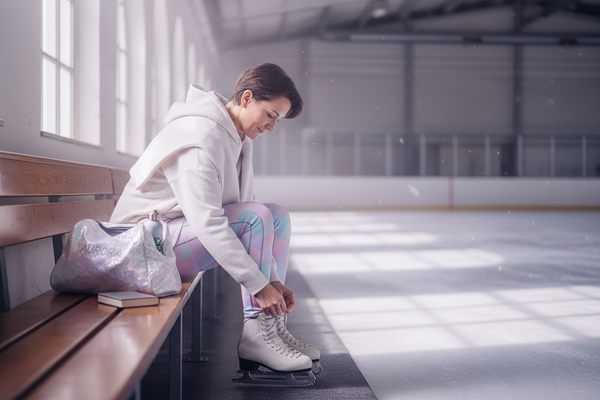
You don't need to buy skates yet. You don't need to "get in shape first." You don't need to watch YouTube tutorials. Rental skates are fine for your first few sessions. Wear leggings or athletic pants (no jeans), layers on top, and gloves. That's it. Our first skating outfit guide covers everything.
⚠️ What NOT to wear
No jeans (too stiff, get wet fast). No baggy pants (can catch on your blades). No cotton socks (they get cold and soggy). Wear tall athletic socks, stretchy pants, and layers you can peel off - you'll warm up faster than you think.
Step 3: Give it 4 - 6 sessions before deciding
The first session is awkward. Everyone's first session is awkward. By session three you'll be moving. By session six you'll wonder why you didn't start sooner. Don't judge the sport by the first wobbly 30 minutes - give it a real chance.
What it costs (real numbers)
Let's be honest about this because "just try it!" is easy to say when you don't know the price tag.
| Expense | Cost | Notes |
|---|---|---|
| Group lesson (per session) | $15 - 25 | Usually 6 - 8 week blocks |
| Private lesson (30 min) | $40 - 80 | Varies hugely by region and coach |
| Public session ice time | $8 - 15 | Per session, includes rental |
| Skate rental | $3 - 7 | Free with most lessons |
| Your own skates | $200 - 470 | When you're ready (usually 4 - 8 weeks in) |
The bottom line: you can start skating for the cost of a gym membership. A group lesson series plus a few practice sessions runs $100 - 200 per month. You don't need your own skates until you're sure you want to continue - and even then, solid beginner skates start around $200. Our boot and blade buying guide breaks down every option by price and level.
The gear you need (and don't need) on day one
For your first few sessions, you need almost nothing. Seriously. Here's the actual list:
Day one essentials
- Leggings or athletic pants - stretchy, fitted, moisture-wicking
- Layers on top - a fitted long-sleeve plus a zip-up jacket you can remove
- Gloves - your hands will touch the ice (and it's cold)
- Tall socks - athletic, not cotton (cotton gets cold and soggy fast)
- Water bottle - you'll be thirstier than you expect
That's it. Everything else comes later, if and when you want it.
When you're ready for more
After 4 - 8 weeks of regular skating, most people are ready to invest in their own skates. This is the single biggest upgrade you'll make - going from fighting rental skates to actually feeling the ice under your feet changes everything.
⛸️ Beginner skate picks for adults
Budget-friendly: Jackson EVO Fusion (~$250 - 280 as a set) or Riedell Topaz (~$200 - 250) - both heat-moldable with enough support for an adult body.
Stepping up: Jackson Freestyle Fusion (~$470 set) or Edea Overture (~$300 - 350 boots only, blades separate) - for adults planning to work toward jumps and spins.
Avoid: Amazon no-brand skates, Jackson Softec/Mystique (too soft for adults), and anything over stiffness 70 (too rigid for beginners). Full breakdown in our ultimate boot guide.
Beyond skates, the only other things you might want are blade guards and soakers to protect your blades, and comfortable skating apparel that actually moves with you. (Jeans at the rink? We don't know her.)
Gear up for the ice
Skating apparel, accessories, and gear designed for adults who actually skate.
Frequently Asked Questions
Yes. Figure skating burns 300-600 calories per hour and works your core, legs, glutes, and balance. It is a full-body workout that also improves coordination, flexibility, and cardiovascular health.
No. Adults of all ages start figure skating - from their 20s through their 70s and beyond. U.S. Figure Skating and ISI both have adult programs specifically designed for people who start later in life.
You do not need to be athletic. Figure skating builds fitness as you go. Most adult beginners start with basic balance and stroking skills and progress at their own pace.
Figure skating improves mood, reduces stress, and builds confidence. The combination of physical exercise, music, and creative expression makes it especially effective for mental wellbeing.
Getting started costs roughly $15-25 per group lesson plus public session ice time ($5-15). Many rinks offer beginner packages. You can rent skates at first before investing in your own pair.
To start, you need figure skates (rentals work initially), warm athletic clothing, and gloves. As you progress you may want your own boots and blades. See our best figure skates guide for recommendations.
Yes. U.S. Figure Skating hosts Adult Championships and Adult Sectionals with divisions for all levels, from pre-bronze through gold. ISI also offers adult competitions.
Most coaches recommend 2-3 times per week for steady progress. Even once a week will help you improve, especially if combined with off-ice training.
Check your local ice rink for Learn to Skate USA programs, or search the complete beginner's guide for tips on finding classes and coaches.
Most dedicated adult skaters learn all basic skills including crossovers, spins, and single jumps. Some adults progress to double jumps and compete at national levels.