
The Backflip Is Back
Banned for 50 years. Done in defiance by Surya Bonaly. Now Ilia Malinin is landing them on Olympic ice — and the debate about who gets celebrated for it has the skating world divided.
If you've been watching the 2026 Winter Olympics in Milan — or honestly, just scrolling social media for five seconds — you've seen it. Ilia Malinin launching himself into a backflip on Olympic ice, landing on one blade, and the entire arena absolutely losing it.
But behind the jaw-dropping athleticism is a story that spans five decades. It involves rule-breaking rebels, a long-standing ban, questions about who gets celebrated and who gets punished for the same move, and a debate that has the skating world buzzing louder than ever right now.
Let's break it all down.
First, a Quick History: How Did the Backflip Get Banned?
The backflip first appeared at the Olympics in 1976, when American skater Terry Kubicka landed one at the Innsbruck Games. He was the first skater to successfully pull it off in international competition. He'd gotten the idea from his coach, Evy Scotvold, who wanted to push athleticism beyond the triple jumps that were the hardest elements at the time.
The International Skating Union's response? They banned it. The very next year.
Their reasoning was twofold: the move was considered too dangerous, and it violated a core principle of figure skating — that jumps must land on one skate. Kubicka had landed on two feet. The ISU essentially decided this kind of acrobatic trick was more circus than sport, and it had no place in competitive skating.
For the next 47 years, the backflip was listed as an "illegal element" on official scoresheets. If you did one in competition, you didn't just get zero points — you actually lost points for it.
Enter Surya Bonaly: The Moment That Changed Everything
If you know anything about the backflip in skating, you know the name Surya Bonaly.
Bonaly was a powerhouse. A French skater, three-time World Championship silver medalist, five-time European champion, and a nine-time French national champion. She was also one of the very few Black women competing at the top levels of figure skating — a sport that has historically been overwhelmingly white.
Throughout her career, Bonaly was known for her incredible athleticism. She was a former gymnast who brought raw power and acrobatic ability to the ice. But she was also consistently critiqued by judges — and many of those critiques, observers noted, seemed to be more about her appearance and her style not fitting the traditional "balletic" aesthetic of skating than about her actual skill.
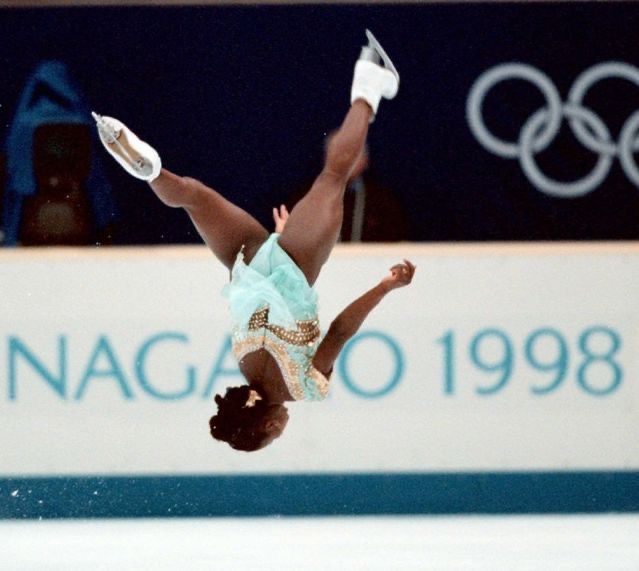
At the 1998 Nagano Olympics, Bonaly was 24 years old and recovering from a severe ruptured Achilles tendon that had nearly ended her career two years earlier. She knew she wasn't going to medal. She was in pain toward the end of her free skate and realized she couldn't land the final triple jumps she had planned.
So she made a choice that would become one of the most iconic moments in Olympic skating history.
She threw a backflip. And she landed it on one single blade. Something no one had ever done before in Olympic competition.
She knew it was illegal. She knew the judges would dock her points. She did it anyway.
The crowd went absolutely wild. Bonaly finished 10th — she would have placed 6th without the deduction. But the moment cemented her legacy forever. It was an act of defiance, of self-expression, and of an athlete refusing to leave the ice quietly.
2024: The ISU Finally Lifts the Ban
For decades after Nagano, backflips lived on in ice shows, exhibitions, and the occasional viral video — but never in competition. Skaters like Scott Hamilton (1984 Olympic gold medalist) kept doing them in professional shows, but the ISU held firm on the ban.
Then, in 2024, the ISU officially reversed its position, making backflips legal again starting with the 2024-2025 season. Their explanation on the meeting agenda was straightforward: "Somersault type jumps are very spectacular and nowadays it is not logical anymore to include them as illegal movements."
Translation: the sport needed to evolve, younger audiences were turning to more exciting winter disciplines, and keeping the backflip banned just didn't make sense anymore.
Here's the Catch, Though
The backflip is now allowed, meaning you won't be penalized for doing one. But it's still not a scored element. It doesn't count toward a skater's technical score at all. It's essentially worth zero points.
It can boost a skater's artistic components score slightly — but doing a backflip in competition is a genuinely high-risk, low-reward move. If you land it? Zero technical points. If you fall on it? You lose points for falling on a move that wasn't worth anything to begin with.
So why do it? Because it brings the house down. And for some skaters, that matters.
Ilia Malinin at the 2026 Olympics: The Quad God Flips
Enter Ilia Malinin, the 21-year-old American nicknamed the "Quad God" for his absolutely ridiculous jumping ability. Malinin trained in gymnastics when he was younger, and he first debuted his backflip in competition in 2024, the same year the ISU lifted the ban.
On February 8, 2026, during the team event at the Milano Cortina Olympics, Malinin landed a backflip on one blade — the first legal backflip in Olympic competition in 48 years, since Terry Kubicka in 1976.
He did it in his short program on Saturday, then did it again the next day in the free skate, helping Team USA clinch the gold medal in the team event. Tennis legend Novak Djokovic was in the audience with his family and was spotted standing with his hands on his head in disbelief.
Then on February 10, in the men's individual short program, Malinin landed yet another backflip and skated into the lead heading into the free skate on February 13. He admitted that the first time on Olympic ice had been overwhelming — "I didn't expect it to be so much" — but said he adjusted his approach and used the backflip to elevate his performance from exceptional to electric.
The Debate: Who Gets Celebrated, and Who Gets Punished?
And here's where it gets complicated — and important.
As Malinin was being showered with praise for his backflips, social media erupted with a very pointed question: why is Ilia Malinin being celebrated for the same move that Surya Bonaly was penalized for?
The move is even known today as "the Bonaly flip" — named for Surya herself. Yet it's Malinin getting the gold medals and the standing ovations.
Now, the factual context matters here. When Bonaly performed her backflip in 1998, the move was illegal. She knew it, and she did it as an intentional act of defiance. Malinin is performing the move legally, after the ISU changed its rules. Those are different situations from a pure rules standpoint.
But the broader conversation isn't just about the rules — it's about why the backflip was banned in the first place, who bore the consequences of that ban, and the patterns of whose athleticism gets embraced versus dismissed in figure skating.
Critics point out that Bonaly was consistently judged more harshly throughout her career. Her powerful, athletic style was often described as "not artistic enough" — while today, that same kind of athleticism is exactly what the ISU says it wants more of. Many have noted that critiques of Bonaly often seemed to be about her appearance and her refusal to conform to the traditional aesthetic expectations of the sport rather than about her actual abilities.
Bonaly herself, though, has responded with grace. In a phone interview with the AP from her home in Minnesota, she said she was glad to see the backflip on Olympic ice again and that skating needs to be taken to a higher level.
Regarding the criticism she received during her own career, she said simply that she was "born too early" — arriving on the scene at a time when people weren't ready for something different.
And Then There's Deanna Stellato-Dudek: The 42-Year-Old Backflipper
Because this story wasn't already wild enough, let's add another layer.
Deanna Stellato-Dudek — the 42-year-old Canadian pairs skater, 2024 World Champion, and absolute legend of the "it's never too late" movement — has been doing an assisted backflip off her partner Maxime Deschamps' chest this season. They are the first pair skating team ever to perform an assisted backflip in an ISU competition.
Her motivation? "Last year the ISU just allowed backflips and Adam Siao Him Fa has done it and Ilia Malinin is on it but none of the women have done it," she told the ISU. "I wanted to show that the girls play the backflip game just as good as the boys."
Deschamps was initially firmly against the idea. Stellato-Dudek's first proposal was to backflip off his shoulders. He said no. Then she suggested jumping off his back. He pointed out her blades would cut him. ("Stick pads in the costume, you'll be fine," she reportedly told him.) She eventually found a YouTube video of a kid doing a similar flip off his dad's chest and convinced Deschamps to try it. She landed it on day one.
Stellato-Dudek was cleared to compete at the Olympics just yesterday, February 10, after hitting her head during training on January 30. She and Deschamps plan to perform the first assisted backflip in Olympic competition during their pairs short program on February 15 — set to "Carmina Burana," no less. She'll be skating in costumes designed by Oscar de la Renta.
At 42. After a 16-year break from skating. Doing a backflip at the Olympics.
If that's not an Adults Skate Too energy, nothing is.
The Backflip Timeline
American Terry Kubicka becomes the first skater to land a backflip in international competition. He lands on two feet.
The ISU bans the backflip, citing safety concerns and the rule that jumps must land on one skate.
Surya Bonaly of France performs an illegal backflip and lands on one blade — the first person to do so at the Olympics. She is penalized and finishes 10th.
The ISU officially lifts the backflip ban for the 2024-2025 season, calling somersault-type jumps "very spectacular." Ilia Malinin debuts his backflip in competition at the Lombardia Trophy. Stellato-Dudek and Deschamps become the first pair to perform an assisted backflip in ISU competition.
Ilia Malinin lands the first legal backflip on Olympic ice in 48 years, helping Team USA win gold in the team event. The debate about Bonaly's legacy explodes on social media.
Stellato-Dudek and Deschamps plan to perform the first assisted backflip in Olympic pairs competition.
So Where Does This Leave Us?
The backflip debate isn't a simple one, and it shouldn't be. Multiple things can be true at the same time:
Ilia Malinin is an extraordinary athlete who is doing something genuinely thrilling and legal within the current rules, and he's bringing new fans to the sport by doing it. He deserves the praise he's getting.
Surya Bonaly was ahead of her time, and the way she was treated — both for the backflip and throughout her career — reflected biases that the skating world is still reckoning with. She deserves far more recognition than she's historically received.
And the ISU's own evolution on this issue — banning the move for nearly 50 years and then reversing course because they decided it was "spectacular" and good for the sport — invites real questions about who gets to define what figure skating is and who it's for.
Bonaly said it best: she broke ice for other skaters. The backflip went from forbidden to featured. And a 42-year-old woman is about to do one at the Olympics off her partner's chest because she wanted to prove that "girls play the backflip game just as good as the boys."
The sport is changing. It's messy and complicated and not everyone agrees on where it should go. But honestly? That's what makes it interesting.
The Adults Skate Too Take 🛼
No, we are not recommending you try a backflip at your next public skate session. Please do not. Your chiropractor will thank us.
But what we love about this whole saga is the reminder that skating has always had room for people who don't fit the mold — people who are "too old," "too athletic," "too different," or "too much." Surya Bonaly didn't fit the mold and she changed the sport anyway. Deanna Stellato-Dudek came back to skating at 33 after a 16-year break and is now doing backflips at the Olympics at 42.
If that doesn't make you want to lace up and get back on the ice, we don't know what will.


